by WUUC | May 3, 2016 | Minister Blog
Years ago, I had the privilege of hearing author and activist, Leslie Feinberg, speak about transgender issues and politics. What really made an impact on me was when Feinberg talked about the fact that transgender persons have to make a decision every time they need to use a public restroom: attend to an urgent, normal, bodily function or put one’s life in potential danger. As someone who is cisgender (meaning that my “self-identity conforms with the gender that corresponds to my biological sex”) I am never faced with that decision. No one should be. But that is just what the coalition, “Just Want Privacy” wants to make the law in Washington.
Initiative 1515 would declare “null and void” the 2006 Human Rights Commission’s rule that guarantees bathroom access for transgender people. But the initiative goes even further by banning the commission from ever “adopting rules related to gender identity in sex-segregated facilities.” It prohibits transgender students from using “sex segregated” bathroom in schools, allowing them to use only “single stall or unisex bathrooms “or controlled use of faculty bathrooms, locker rooms, or shower rooms.” The initiative also allows students to sue schools for $2500 each time they encounter a person of the opposite sex when accessing sex segregated restrooms, locker and shower rooms.
Based on the fear and distortion of truth tactics used by the Just Want Privacy coalition, I have no doubt that they will gather the required number of signatures by July so that the initiative will come before Washington voters. Having lost the battle in the courts to discriminate against gays and lesbians, groups like Just Want Privacy and conservative legislators are now turning their discriminatory sights on transgender persons. Last Thursday, the group Washington Won’t Discriminate, kicked off its campaign to challenge and defeat Initiative 1515. The byline for this campaign is, “Discrimination is not a Washington value.”
This initiative needs to be named for what it is: discrimination. And it needs to be defeated. All of us need to educate ourselves and others on the facts of the initiative and the Human Rights Commission rule of 2006. We also need to educate ourselves and others about the facts and truths of transgender lives. One book that I have found very helpful recently is Trans/Portraits: Voices from Transgender Communities. And we are lucky to have an annual conference held each August in Seattle: Gender Odyssey which is for professionals and laity, as well as families, transgender folks, and allies. But we don’t have to become experts to understand that discrimination is not a UU value. I ask you to join me and others to defeat Initiative 1515 and any other future proposed transgender discriminatory legislation.
Peace, Shalom, Salaam,
Rev.Lo

by WUUC | Apr 28, 2016 | Minister Blog
I was asked the other day what “Voluntary Simplicity” is. I have often associated it with those of us who come from a privileged background who have filled our lives up with “stuff.” For folks struggling with poverty, simplicity is a forced choice, not an option. But voluntary simplicity is not about economic status or class. It is a way of living in alignment with ones values of stewardship of the earth and not being controlled by our possessions or the job rat race. It is about focusing on what has meaning and importance and value in our lives. A writer on the Voluntary Simplicity Blog puts it this way:
“I think of simple living as a lifestyle with a deliberate focus on paring away the unnecessary and eliminating excess. Simple living is about learning to do things for yourself and being as self-sufficient as possible. It’s about being frugal (but not stingy) with your resources and your time, taking steps to reduce and hopefully eliminate your debts, and preparing wisely for the future.
I believe that voluntary simplicity goes way beyond HOW you live and is more about the WAY you live… and how you interact with the world around you… it’s also about happiness, contentment…”
Simplicity is the theme for the month of May. In what ways are you choosing simplicity?
Rev.Lo
by WUUC | Apr 28, 2016 | Minister Blog
Why does it take so much time, effort, and resources to live simply? There are a zillion books out there about how to pare down one’s possessions: hold each item and ask yourself is it useful, do you love it, etc. Make three piles of your stuff: keep, maybe, discard. Certainly culling one’s possessions simplifies ones life. To live more simply in a world of fast and convenient is a full-time job. There is a wonderful book and film called “No Impact Man” written several years ago about one family’s attempt to live for a year in New York City with as little impact as possible. It took a whole lot of research and a whole lot of time. And in this world of one-use items, it is expensive for anyone to choose products that have less environmental impact than one-offs. Living simply in today’s world is a full-time job.
But simplicity is about much more than product choices. It is at its core, about values. Duane Elgin, often regarded as the architect of  the voluntary simplicity movement, writes, “Simplicity that is voluntary—consciously chosen, deliberate, and intentional—supports a higher quality of life.” He points out that the movement is often oversimplified as a “back to nature, regressive movement.” He says that in recent years, simplicity in the mainstream has been merely cosmetic: “putting green lipstick on our unsustainable lives.” In other words, changing the kinds of light bulbs we use and recycling skim the surface of the deeper problems of consumerism run amuck. Deep simplicity “is a conscious simplicity that represents a deep, graceful, and sophisticated transformation in our ways of living… it seeks to heal our relationship with the Earth, with one another and with the sacred universe.”
Simplicity is about mining for meaning in a world full of “shiny pennies” and pulls on our time. It is about realizing that no one else is in charge of our calendars. It is about valuing relationships and putting time into forming and sustaining them. It is about being intentional not just about what we will consume but in determining what will consume our time. It is not necessarily living without technology but deciding how much of our lives will we turn over to it.
One of Elgin’s key points about voluntary simplicity is that it is liberating. There comes a time in our lives when it seems that our possessions own us, demanding our time, energy, and money. But letting go not just of things but also of time-sucking activities allows us freedom. Simplicity is not about sacrifice; rather it is about a richness of life lived with intention and attention. It is about living in alignment with one’s values.
The theme for this month of May in our worship and religious education is “simplicity.” I invite you to ponder what it means for you and how you live your lives. Does the idea of simplicity terrify you or intrigue you? What can it look like in your life?
Peace, Shalom, Salaam,
Rev. Lo
by WUUC | Apr 25, 2016 | Minister Blog
As I pulled into the driveway to church on Sunday, I noticed that our “Black Lives Matter” sign was missing from the wayside pulpit. Upon closer inspection, it was clear that the sign had been ripped down as I found the clips used to hold it in place on the ground. It was the third act of vandalism at the church in 3 days.
After the service, we held the annual Town Hall meeting where folks go over the proposed budget and other items that will be voted on at the congregational meeting in May. It is the time to ask questions or raised concerns.
In September, I had preached a sermon on why “Black Lives Matters” and no that is not a typo. In it, I stated that I had put the BLM sign up and it was up to the congregation to decide if it is to stay up or come down. After the service around 50 folks sat at tables and talked about BLM. I offered a 9-week course using the book Witnessing Whiteness and out of that an ongoing group is meeting once a month. The Rev. Meg Riley preached movingly about her and her child’s involvement and support of BLM.
At the last Board meeting, I asked that the issue of the sign staying up or coming down come before the congregation for a vote. For me it is about honoring my commitment to the congregation to have them make a choice. At the Town Hall, the question was asked, “How long will the sign stay up?” I wish I could have answered saying that racism will end or that racial justice in this country has been served. But neither of those things has been realized. Frankly, I doubt they ever will. But what that means for me, as a person of faith is that I will continue insisting that the lives of people of color matter- sign or no sign.
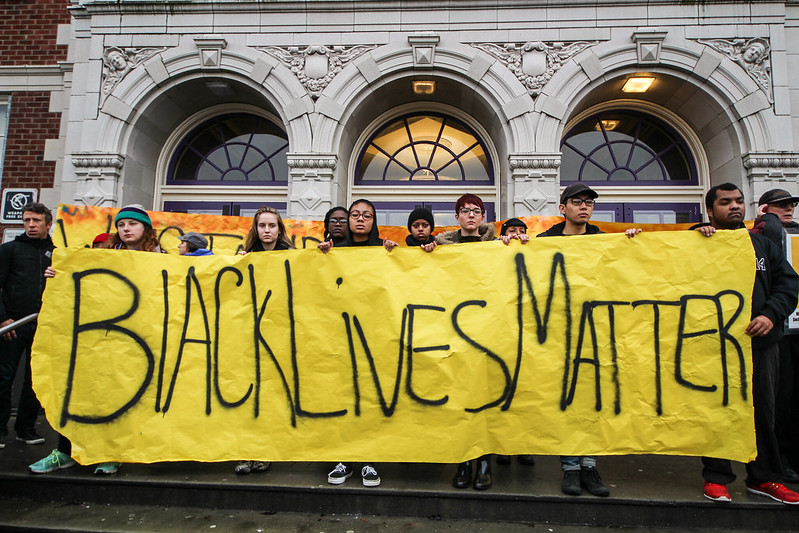
Image credit Flickr user scottlum
The reminder that Black Lives don’t seem to matter was brought home Monday morning when Grace Simons texted me asking if we were going to respond to the acts of vandalism committed over the weekend at the Curry Temple Christian Methodist Episcopal (a traditionally Black church) in the central district of Seattle. The vandals spray painted “Go back to Africa,” swastikas and “N.” They also ransacked the church office. Someone has already started a “Go Fund Me” account with the goal of $5000 toward repairs (donate here). A rally will be held at the church this weekend and there are numerous offers to come help and paint posted on the church’s Facebook page.
Seeing pictures of some of the elders sitting in the church sanctuary with the graffiti in the background was profoundly disturbing. For centuries, the Black church in this country has been the only place that granted Black men authority, dignity, and respect in their role as pastor. In fact, it was nearly the only leadership role that whites allowed Black men. And the Black church has historically been the place not only of refuge and safety but of sustenance, inspiration, and liberation. To vandalize Black churches is to vandalize the hearts and spirits of Black congregants.
I wrote on the church’s Facebook page that such an act of vandalism to one community is an affront to all communities of faith. We may or may not be asked to come armed with paint and paintbrushes. Or to come with our hearts open to stand with and alongside as witnesses not just to injustice but to love. May we all respond.
Black Lives Matter.
Peace, Shalom, Salaam,
Rev.Lo
by WUUC | Apr 21, 2016 | Minister Blog
Thanks to Ron Hammond, I learned that Earth Day was actually an idea of a Unitarian Universalist: Morton Hilbert, a professor of public health and civil engineering who was a world authority on public water supplies. He was also, in his retirement years, a member of the Eastshore UU Church in Bellevue.

Hilbert encouraged his graduate students to work for the establishment of Earth Day though they would all credit him as being the inspiration for the day.
The idea for an Earth Day had its beginnings in a conference sponsored by the U.S. Public Health Service as a way to get college students interested in the environment. Hilbert, who was in attendance, helped students obtain a government grant and worked with them for two years to get the first Earth Day established in April of 1970. It is considered to be the beginning of the modern environmental movement.
Join us this Sunday, April 24, for a celebration of Earth Day. The folk duo, Emma’s Revolution, will be singing as well as our children’s choir.
Rev.Lo
by WUUC | Apr 8, 2016 | Minister Blog
My friend Jill and I had sworn to one another that no matter where we were in ministry in the summer of 2000, we would take youth on a trip somewhere. So when I got a call from her in the fall of 1999 asking me if I wanted to take youth to Transylvania come summer, I said, “Sure!” And then got off the phone and looked up where Transylvania was on the map. I was still in the United Church of Christ at the time and was not aware of the importance of Transylvania to Unitarianism. By the end of that trip, I was well aware of the importance and on my way to becoming a UU and leaving the UCC.
I learned many things about Unitarianism and Transylvania that summer. The whole Dracula thing is just so annoying and frankly, offensive- though we did visit the supposed castle. Unitarians in Transylvania celebrate communion and use the Lord’s Prayer. They also affirm a God and on many pulpits, you will see these words: “Isten egy” which means, “God is one.”

Interior of the wooden church of Cizer, Cluj*
The ministers wear heavy black capes to preach in. There is a societal pecking order in Romanian society: Romanians at the top, then the ethnically Hungarians (which the Transylvanians are) and then the Gypsy or Roma people. When the 40 or so of us all went camping, there was no fancy gear. The main tent was an old Russian Army tent. The “cook stove” was a huge cast iron kettle where many of our meals were made. There were several cultural differences between the American youth and the Transylvanian youth. The one I was most aware of was that when U.S. youth were asked anything in a discussion, they automatically jumped in and answered. The Transylvanian youth were slower to speak, spoke with their heads down, and spoke softly. Under the dictatorship of Ceausescu, neighbors spied on neighbors. People hid their beliefs and their feelings. A concept totally foreign to the youth from the U.S.
Two years later, the UCC church I served and the local UU church as well as Jill’s church in Michigan worked together to bring 16 Transylvanian youth and 4 adults to the states. Many of you may be aware of the Partner Church Program that was started after Romania began to open up again after Ceausescu was deposed. UU Churches in the U.S. were matched to Transylvanian churches. The program consisted of many Americans visiting their partner churches in Transylvania and sponsoring Transylvanian ministers to visit the U.S. But no one had raised money to bring Transylvanian youth to the states. The UCC and UU churches raised $30,000 to make this happen. Given the difficult economic situation in Romania at that time (2002), this sort of trip would forever been out of reach for the Transylvania youth.

Merry Cemetary of Sapântsa by Spiridon Ion Cepleanu
One of the things we did was set up an entire day of volunteering at the animal shelter and at the Food Bank. This concept of service or volunteerism was entirely new to the Transylvanians. The youth had also requested to see a hospital and a farm. We took them to both. As it was June, strawberries were in ripe so we all had a blast picking them at an organic farm. We then contrasted that experience by visiting a factory farm. One of the young women on the trip said that tasting the strawberries was familiar but new- a way to connect an experience of home to an experience in the U.S.
This summer, Paige Marler, Kensi and Kylie Hartman, and Ashley Lacy will join a national youth trip to Transylvania. While there they will do many of the things I got to do in 2000 such as visiting the historical Unitarian sites. They will also have the chance to do a service project. In support of this project and to raise awareness of our Transylvanian roots, the youth will be holding a Hungarian dinner on Saturday, April 16 at WUUC. Rosemary Lowden will be showing her photos from her trip there this fall.
I would encourage as many of you as possible to attend this event; more information can be found here. And then, to come to church on Sunday, August 21 to hear these youth report back to us about the trip and their experiences.
Rev. Lo
* Photo Credit Original uploader was Albabos at ro.wikipedia – Transferred from ro.wikipedia; transferred to Commons by User:Kurpfalzbilder.de usingCommonsHelper.