by WUUC | Apr 1, 2015 | Minister Blog
 To believe. Credo. To know that something is true. The things one knows. This, I believe. And then there is faith. Not knowing. To trust the unknown. This, I will give myself to. Beliefs can be wrong. The world isn’t flat. Faith isn’t right or wrong though it maybe foolish or unfounded. God didn’t create AIDS as punishment for promiscuity. At least not the God my UU ancestors have been deconstructing the past 200 years.
Easter always brings up belief and faith. Fact versus the metaphorical. There are those who know that the events of that Sunday long ago are true, true, true. And there are others, equally as faithful, who only know (as many colleagues have said) that something happened. We have not a clue what that something was or is. The veracity of what happened has never been the point. It was and is the story that has stuck. A story that continues to elicit belief and faith. As well as disbelief and incredulity.
Colleagues around the globe, from liberal Christian traditions and our own, are scrounging around, trying to find a way to preach one more time on the theme of Easter. What can any of us say or add that is new? We can talk about bunnies and baskets and chocolate eggs and the Hare in the Moon, and Eostra. We can praise spring and flowers and the earth’s rebirth. We can talk about the Passover and liberation of the ancient Hebrews. We can talk about faith, belief, betrayal, grief, human frailty, denial. Of the rocks, the obstacles of our lives being rolled away to reveal an empty tomb, a hollow space from which to begin anew.
For this year, I’m going to go with this time, this season, this Easter being the birth of the possible in our lives. With believing in ourselves and our abilities. With having faith in ourselves and our capabilities. I’m going with daffodils and the reminder that something happened long ago. Me, I am going to enter into Mystery and trust it.
Peace, Shalom, Salaam,
Rev. Lo
by WUUC | Mar 18, 2015 | Minister Blog
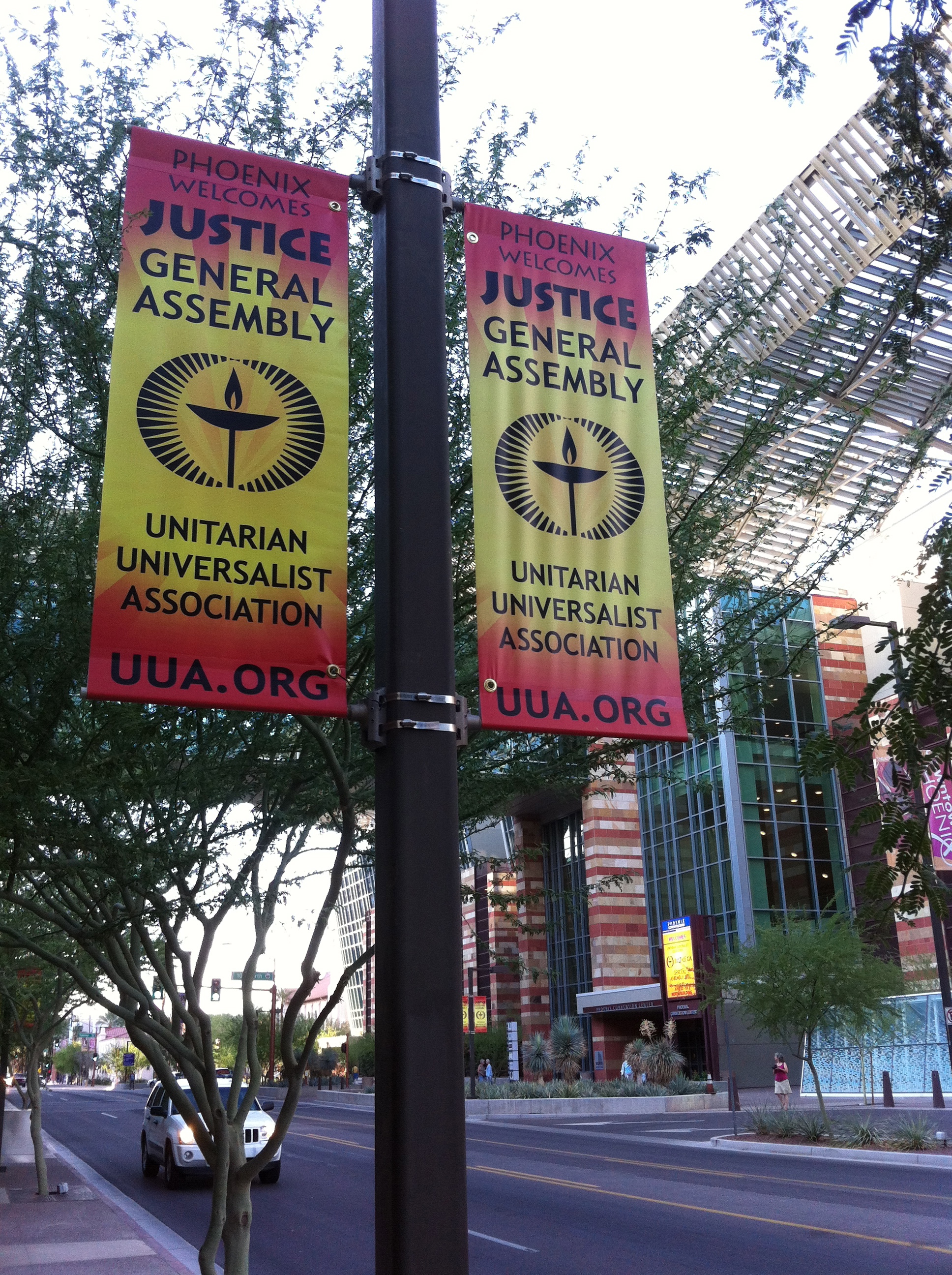
 General Assembly. Portland, Oregon. June 24-28. Imagine 4000 Unitarian Universalists gathered in one place to worship, to sing in the choir, to learn together, to listen to amazing speakers, to connect with others who share our faith tradition, to shop at the vendor tables and the UUA Bookstore, to see our national staff and lay leaders in action, to understand the business aspects and work of the UU Association, and to immerse one’s self fully in the UU Universe for 4 days! And because it is fun!!!
I remember attending my second G.A. in Long Beach, California. It was my second year as an official UU minister. As I approached the convention center where the assembly as held, I was greeted by a huge banner that read, “Civil Marriage is a Civil Right.” I nearly burst into tears. I had worked on GBLTQQI issues throughout the 1980’s and 1990’s when acknowledging the “inherent worth and dignity” of my queer community was not held by the mainstream or even the liberal Christian Church I was serving. And now, here was Unitarian Universalism, my adopted faith, proclaiming my right to love who I love and have that recognized by both the church and the state.
I have also had the privilege of being part of the witness team for the social witness events that were held at the Phoenix G.A. The focus that year was immigration and we were bussed to the site of an infamous “tent city” deportation center. I greeted each bus that came and gave folks instructions on where to walk to join the rally. I stood with other colleagues behind the barriers that separated “us from them:” those protesting our presence, the ones who supported the deportations and arrests of undocumented persons. We sang and kept watch as the police placed themselves between our two groups. It was quite a sight that met my gaze when I turned away from the barriers and police and protesters: there was a sea of yellow shirts (the “standing on the side of love shirts”) lit by candles held high by the UU crowd. We had showed up. Just as we had in Selma all those years ago…
If you decide to attend G.A.- which I hope you do- you can be kept busy from 7:00 a.m. until midnight every night. You may find somewhere into day 3 that you have hit a wall and need to take a time out to nap or poke around downtown Portland. This is all part of a G.A. experience. If you decide to go, know that meals are on your own. In addition to the $350 registration fee, you need to secure lodging as well. Chuck Bean has been scouting around for cheaper digs rather than the official G.A. hotels and has come up with the Econo Lodge at Port of Portland which is near the convention center. One group of folks found a house to rent. There is a great light rail system that is stops at the Convention Center from all directions that it runs.
So, go online to the UUA website and check out the links to this year’s G.A. This may be the closest G.A. ever gets to us as they tend to chose “second” tier cities that are not so expensive to hold G.A. There are also options to “attend” via live streaming if you cannot get down to Portland to be there in person.
I hope to see many of you there!
Peace, Shalom, Salaam,
Rev. Lo
by WUUC | Mar 4, 2015 | Minister Blog

Click here for March, Journeys
I spent the last two days in a workshop about “faith formation.” There were a few UU colleagues present as well but most of the folks attending were Christian ministers or educators or lay leaders. So my colleagues and I spent a lot of time “translating” the language into Unitarian Universalism. My definition was “whatever wakes you up and kicks your butt.” (More on that in a sermon later.) But the definition that was shared that I found really useable for UU’s is, “ Finding one’s story. The story that sustains you and helps sustain the universe- a road map for living a good life.”
For us to find our stories, our lives need to be “anchored in a seedbed of relationships.” At all ages and stages of our lives, we need a network of relationships that go with us and accompany us on our journeys. The workshop facilitator called that network of relationships “familying.” The relationships that have the perhaps the most influence on our development as human beings are the blood ties: our biological families or the family structure that we are raised in, blood or adoptive or chosen. Then there are the household relationships that affect our development: the relationships we have with those whom we live with. And finally there are the essential relationships of our “chosen family:” those who we have gathered into our hearts. This is the pool of relationships upon which we can draw to build foundational, sustaining, nurturing relationships.
I also learned that research shows that there are 5 moments in daily life that contribute to households and families functioning and liking one another. Moments that lay the groundwork for deeper, more connective relationships:
Moment 1: Exits and Entries: how do you and those you share a household or life with take leave of one another and enter common space together after absence? Are there words exchanged? Physical contact made like a hug? Eye contact? A text or Facebook message? Pay attention to these as a moment of connection.
Moment 2: Bedtime: how does your household wind down the day? Are folks in bed glued to screens? Is there any snuggling or reading out loud to one another or talking to one another? A Walton’s moment goodnight exchange? Or do folks retire separately without any words or connection?
Moment 3: Mealtime: yes I know that is become somewhat of an endangered phenomenon. Could it be reclaimed in some way? Could all media devices be turned off and actual conversation be had. Not as in, “How was school today, “ or “How was your day,” but perhaps, “what are you grateful for today?” Or, “what went right for you today?” Connection with real live voices.
Moment 4: Car time: Most of us in this area spend an inordinate amount of time in our cars going hither and yon, often with kids in our cars. What if we didn’t put in the DVD or didn’t all slap in ear buds or have our faces buried in our phones? What if we talked? I used to travel with youth and always banned the radio or walk persons. I made them tell me stories. Sometimes we picked a theme as in tell me a story from your life involving water. Or tell me something from when you were 6. Stories are connection.
Moment 5: Memory Making Moments: moments in household life that cry out to be remembered -the moments that just happen. We create a shared history and ties by retelling stories of events that involved folks. This happens for friends and family and even co-workers. They build upon each other, deepening ties and connections.
We are a relational species. We have need of one another. We find our own stories and develop our own road map by the journeys we travel in the company of relationships. So seize the 5 moments of potential connection in each day. Find your peeps and carry on…
Peace, Shalom, Salaam,
Rev. Lo
by WUUC | Jan 20, 2015 | Minister Blog
 “In algebra, the letter ‘x’ is often used to represent an unknown quantity or variable. Similarly, in English, x represents the unknown, as in X-rays, which baffled their discoverer, and Malcolm X, who chose the symbol to represent the forgotten name of his African ancestors.”
For those of you who did not attend the workshop last Saturday and even for those of you who did, it is not at all ironic that we named the story of WUUC that we are yet to create or live into, “X.” By the way, the only reason that we did not come up with another name was that we were limited by time agreements to end at a certain time. When stumbling around the Internet after reading more about the meaning of “X,” I found the above definition of the letter. But “unknown” means anything but a void. Rather it is spacious, filled with potential, limitless possibility. It denotes exploration, research, and adventure.
I also loved the one of the definitions of the symbol of “X” that Board member Karen Hyams found: “soul of the world.” Says Wikipedia:
“The world soul (Greek: ???? ??????, Latin: anima mundi) is, according to several systems of thought, an intrinsic connection between all living things on the planet, which relates to our world in much the same way as the soul is connected to the human body. The idea originated with Plato and was an important component of most Neoplatonic systems…
Therefore, we may consequently state that: this world is indeed a living being endowed with a soul and intelligence … a single visible living entity containing all other living entities, which by their nature are all relate.” The “X” represents the two bands that come together to form the soul of the world.
How cool is that?! Now, I am not arrogant enough to say that WUUC is the soul of the world. But given our conversation on Saturday that included the concepts of “power” (authenticity and full engagement with life and connection with others) and “love” (as in Agape or Big Love beyond the self and for others and the world), I became intrigued. What if the two bands that come together at WUUC to tell our story are power and love which form the soul of the church? Or, what if WUUC’s story was titled “Empowered by Love?” Empowered to do and be for one another and the world?
All of this may be pushing a symbol too far. Or trying to make it okay that “X” is the placeholder for our story until we come up with a title. But frankly, I am grateful for the knowledge that “X” contains the unknown. And that it is the embodiment of our 7th principle: “ Respect for the interdependent web of all existence of which we are a part.”
Peace, Shalom, Salaam,
Rev. Lo
by WUUC | Dec 11, 2014 | Minister Blog
 Chalica. “Really,” I thought to myself dismissively. Yet another UU way of being politically correct. And banished even the thought of it from my mind. Until Monday when Caly said to me, “So, Chalica…” I decided I better look into this Chalica and see what I really thought after I actually knew something about it. Chalica emerged out of the desire for some theological students at the Vancouver School of Theology in B.C. in 2005 to have a UU winter holiday all its own. Daylene Marshall went home and wrote up some ideas that she had that she thought would embody UU values. She sent it off to some friends and one of them created a Chalica website and Chalica was born. As simply as that.
Chalica is celebrated for 7 days beginning on the first Monday evening in December. Marshall picked that time so as not to interfere with other winter holidays. Each night a chalice is lit from a central chalice and a principle pondered. Like Hanukkah, by the end of the week, all 8 chalices are lit and burning. Over an evening meal, folks may talk about what that principle means and how they live it out in their lives. Gifts are not a huge part of Chalica. The idea is to give notes or if gifts are to be given, to have them be handmade. UU Amanda Gregory, writing in the Huffington post says, “Chalica also offers a simplicity and flexibility enabling it to meld seamlessly into other festivities. Seven days, seven candles, and seven principles, and from there it becomes whatever you need it to be… We are a young UU family, and we are building our holiday traditions and finding our individual faith paths as we go. For us, Chalica is a perfect way to live our beliefs. It is anything but “just another winter holiday.”
I am not sure that Chalica will become THE UU Winter Holiday that is celebrated in homes and churches. But that doesn’t matter. I understand the UU longing for something distinctly our own this time of year. Chalica neither misappropriates ritual from other traditions nor tries to take those traditions and assign a meaning that was never intended. It is a holiday which is in keeping with all the other winter holidays this time of year that really have to do with celebrating light. Chalica champions the principles that serve as the one uniting commonality in a tradition which is so diverse it sometimes seems to lack a core. So if celebrating Chalica works for you as a way to honor Unitarian Universalism and the return of light, so be it. Blessed be. Amen.
Rev. Lo
by WUUC | Nov 26, 2014 | Minister Blog
 I finally figured out what has been troubling me so much about the articles in the UU World on ministering to both the perpetrators and the survivors of sexual abuse in our congregations: we have no distinctly UU theology, understanding or ritual of atonement, confession, forgiveness, redemption, assurance, reconciliation, and restoration of right relationship. Now I am someone who hesitates to use the word “theology”, as it by definition implies talk about God. And I have no idea anymore what the definition of “God” is. It is a word that is constantly subject to semantic juggling in UU circles to the point where it can mean anything and everything and absolutely nothing. I try not to use words I do not understand. But it seems to me that we UU’s need some sort of grounding in theology, cosmology, ontology, morality, ethics or something that allows us to broach the subject of atonement and forgiveness. Otherwise we find ourselves begging and borrowing from other religious traditions committing the sin of sacramental misappropriation.
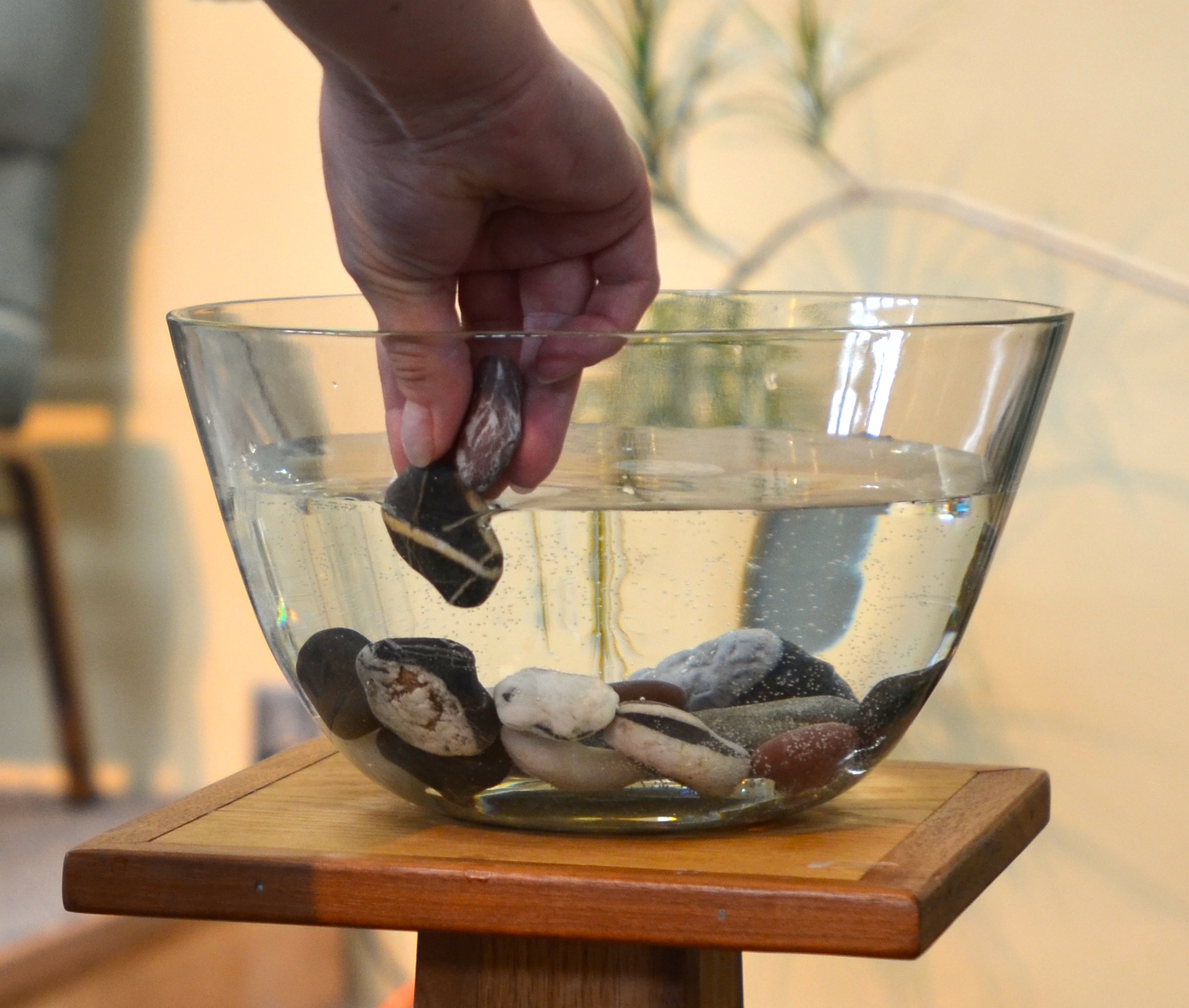
Here is what I know for sure about ritual: we human beings crave it. Ritual allows us to mark the meaning making events of our lives. Ritual makes room for the possibility of the presence of something larger than ourselves to show up. Ritual provides a safe framework to move through the mysteries and challenges as well as the celebration of our lives. I remember a Christian colleague talking about how being beaten into gangs paralleled the ritual of confirmation into church. His point was that we humans will find a way to create rituals out of a vacuum if necessary.
Because I so believe in the role of ritual in religious life, I find myself wanting to ask Unitarian Universalism to stop asking its people to forgive and embrace perpetrators of sexual abuse seeking redemption and restoration to right relationship until it articulates an intentionally religious process and ritual or ontological cosmology (for lack of a better phrase). Forgiveness is a process with its own timeline. It cannot be forced. Similarly we cannot ask congregations to jump to reconciliation and full inclusion of perpetrators of sexual abuse until there has been some sort of ritual engaged in not just by perpetrators and survivors but the entire congregation.
Anyone want to join me in creating a specifically UU ritual that address atonement, confession, forgiveness, redemption, assurance, reconciliation, and restoration of right relationship? Someone else is going to have to articulate the theological or ontological cosmological piece…
Rev. Lo

 To believe. Credo. To know that something is true. The things one knows. This, I believe. And then there is faith. Not knowing. To trust the unknown. This, I will give myself to. Beliefs can be wrong. The world isn’t flat. Faith isn’t right or wrong though it maybe foolish or unfounded. God didn’t create AIDS as punishment for promiscuity. At least not the God my UU ancestors have been deconstructing the past 200 years.