
by WUUC | Feb 21, 2020 | DRE Blog
Stewardship season is upon us again. It is the time in the church year when we are thinking about our pledges, our resources, what we want to give to the church, and what we feel we can afford. It is also the time of year when we plan our annual church budget, which is a true reflection of our values and what we deem important as a congregation.
And so, it seems to me, that it makes sense that we review where we are focusing our money and energy, and what values are being reflected by our choices. As a community, we are doing a lot of wonderful things, but it has everyone spread pretty thin. I feel that acutely in the Religious Education (RE) program. Parents, students, teachers, volunteers and leaders are all juggling so much. It is difficult for anyone to commit more time to anything, including religious education. This has resulted in smaller attendance numbers and fewer volunteers.
In order to best utilize the resources that we do have, the Religious Education Committee has come to the decision to scale back the Sunday morning RE program through the end of May. This means that there will be two Sundays per month in which the children will experience the worship service with the community rather than going to class. (Nursery and pre-school RE will continue every week.) I look forward to the community bonding that we can experience by sharing more worship services with our children.
And even though we are cutting back the number of classes, we
are still in need of more volunteers. As you review your commitments to
WUUC, perhaps you can make a small sacrifice and volunteer to help with one RE
class between now and the end of May. Just one Sunday morning would
reflect that you value the religious education of our community’s
children.
Thank you for all that you do to make WUUC a special and sacred
space.
Peace,
Bridget
by WUUC | Feb 21, 2020 | Announcements
By Jean Fowler
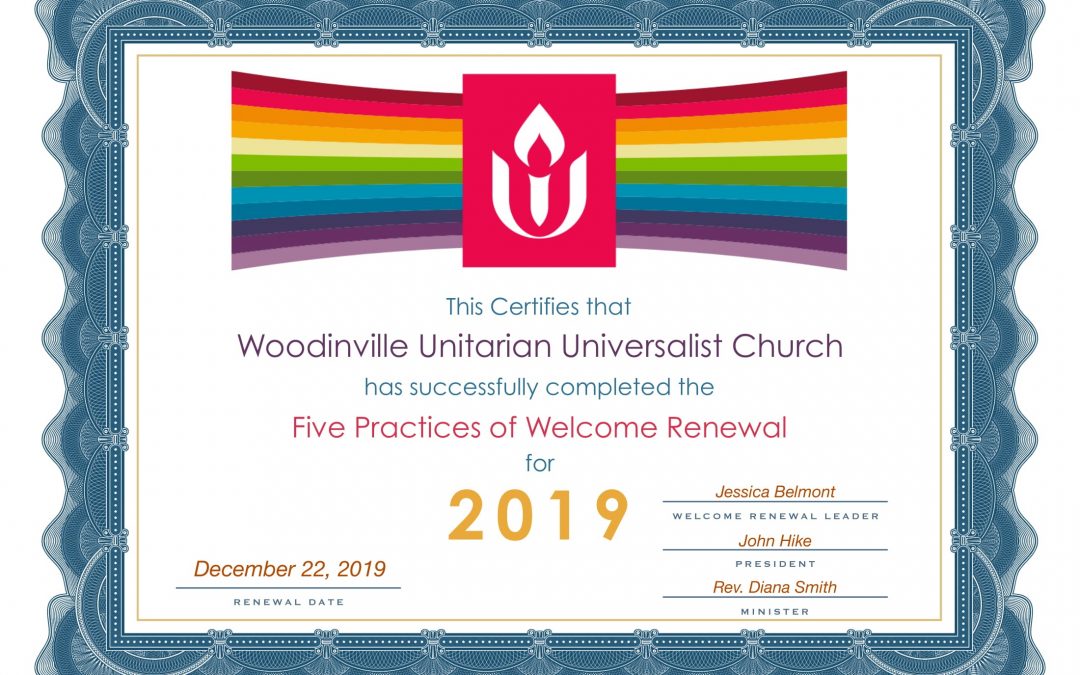
The Woodinville Unitarian Universalist Church became a “Welcoming Congregation” in 1998. This status now needs to be renewed annually and, over the past year, your Welcoming Congregation Committee has successfully completed the renewal tasks.
The Five Practices of Welcome Renewal are five benchmarks
that every congregation will need to integrate into congregational life in
order to ensure that lesbian, gay, bisexual, transgender, intersex, asexual,
two-spirit, genderqueer, non-binary, and the like feel fully welcomed,
centered, and embraced in our Unitarian Universalist congregation.
This past year our congregation has:
**Included Welcoming Worship into our annual calendar such
as recognizing LGBTQ+ PRIDE, and Transgender Day of Visibility
**Observed and celebrated Annual Welcoming Days such as Stonewall
Riots Anniversary, National Coming Out Day and Intersex Awareness Day.
**Held the Preemptive Radical Inclusion Workshop by CB Beal.
**And supported TRUUsT (Transgender Religious Professionals
Unitarian Universalist Together)
Additionally, our congregation has celebrated with the hanging of our LGBTQ+ flag on the front of our church.
Your Welcoming Committee members are: Erika Jackson Kirkendall, Jessica Belmont, Jo Raymond, Emma Rockenbeck, DD Hilke, John Hilke and Jean Fowler.

by WUUC | Feb 21, 2020 | Announcements
By Carol Taylor
Stewardship Chair
As we embark on our next journey with a new minister in the coming year, it’s important to build a solid financial footing to launch our ship. Your contributions are vital to the financial viability of WUUC.
Our annual pledge drive runs through March 15. That’s when we’ll know if we have sufficient budget to extend an offer to a ministerial candidate of our choice. We encourage you to make your pledge today at wuuc.org/future.
by WUUC | Feb 13, 2020 | Announcements
By Donna Johnson
The WUUC Worship Team is committed to ongoing evaluation and improvement. At our retreat last fall we talked about the limitations of what we had been doing for evaluation and developed a new approach. We determined that the overall purpose of our evaluation was to optimize the quality of our worship. Team members developed an evaluation template that asks:
- Were there opportunities for emotional response,
spiritual connection, deepening, and transformation?
- Did the service elements combine in a cohesive
flow?
- What worked? What might be? What should be?
The Worship Team schedules an evaluator from the team for each week. The evaluator uses the evaluation template to draft comments about each element of the service. After the service the evaluator, Worship Associate and others who were involved in the service meet to discuss the things that went well, things that could have been changed, and any lessons learned that can be applied to future services. After the post-service meeting the evaluator finalizes the template, and it is stored on google docs. The whole team reviews the completed templates at our monthly meetings and note important take-aways in the meeting minutes.
We started this process in November 2019, and so far, the team is pleased with how the process is going. Worship Associates appreciate being able to talk about the service with colleagues when the experience is fresh. The team’s monthly discussions seem more helpful and focused because there is a designated person to lead the conversation about each service, and the completed templates are a great way to capture things that might be forgotten if we just relied on our memories.
by WUUC | Feb 13, 2020 | Announcements
There are a few more spots open for the Building Your Own Theology (BYOT) class starting on a new day and time — Tuesday, March 3, 6:30-8:30 p.m. in the WUUC Library. Read below for more information or let Lauren Soliday or Chuck Bean know of any questions you may have.
Sign up HERE.
Greetings fellow seekers of truth. BYOT is an older UU curriculum, but still very relevant to our lives. The class will provide material and exercises to stimulate introspection and discussion on your beliefs and worldview. Your participation will either strengthen what you believe or challenge you to stretch your views. Sound interesting? Please consider joining us this spring for exploring and getting to know yourself and each other better. All are welcome; invite a friend, if you’ve taken it before, but want a “tune-up,” new to WUUC, or long-standing members.
Building Your Own Theology
8 Tuesdays, March 3 – April 21, 6:30-8:30 p.m.
WUUC Library
As
Unitarian-Universalists, we are all theologians. Our church, as a spiritual
community, encourages each of us become more fully aware of own personal credo
(Latin for “I believe.”) This 8-week UUA curriculum will help you examine your
values and beliefs about God or ultimate reality, ethics, and the meaning and
purpose of life. You’ll search for what is true in your life. Through a
combination of reflection, group discussion, study, and writing, you’ll examine
your own spiritual history and articulate your own credo. How does your
life experience inform your faith?
Please
note – this is not a “drop-in” class. It’s important to attend all eight
sessions, since they build on one another.
Facilitators: Chuck Bean (chuckcbean@hotmail.com) & Lauren Soliday (lsoliday@wuuc.org)
Please
let us know your interest ASAP. Write or call with questions or just SIGN UP HERE! Thanks!
Session 1 – “Doing
Theology – Getting Started” – to think about/ depict our own “ultimate reality”
at various points in our lives, create spiritual autobiography
Session 2 – “Your
Religious Odyssey – Autobiography with a Spiritual Twist” – share our spiritual
journey & write our own epitaphs (ie: inscription on tombstone)
Session 3 – “Ultimate
Reality – Creating an Honest God” – consider the nature of Ultimate Reality by
whatever name we call it and survey our personal beliefs and attitudes about
God and prayer.
Session 4 – “Ethics as Unenforceable Obligations” – create a list
of our own ethical Ten Commandments
Session 5 – “We are the Meaning Makers” – explore the sources of
meaning for religious liberals
Session 6 – “Suffering and Meaning” – consider human suffering,
learn how different religions have understood it
Session
7 – “Death and Immortality” – explore beliefs about death and immortality
in various religious/cultural traditions, explore our personal feelings
Session 8 – “Wrapping It Up – A Credo”