The ASJ Committee would like to thank WUUC’s members and friends
for their generous support of our monthly special collections. These
collections take place during services on the third Sunday of every month.
Instructions for giving are posted during the service, and you can also donate
anytime the following week at https://onrealm.org/wuuc/-/give/now, or
by sending a check to WUUC at P.O. Box 111, Woodinville, WA 98072. Please make
checks out to WUUC and write “ASJ Special Collection” in the notes.
Our next special collection will be on Oct. 18, for the Florida Rights Restoration Coalition. FRRC is a grassroots, membership organization run by Returning Citizens (Formerly Convicted Persons) who are dedicated to ending the disenfranchisement and discrimination against people with convictions, and creating a more comprehensive and humane reentry system that will enhance successful reentry, reduce recidivism, and increase public safety. For more information, go to www.FloridaRRC.org.
Although we moved to online services in late March, we’ve
demonstrated that we’re still dedicated to supporting our values with our
money! Below is a list of the special collections from April to August.
April ~ Climate Justice ~ $465
May ~ Black Lives of Unitarian Universalism (BLUU) ~ $755
June ~ Equal Justice Initiative ~ $1,225
July ~ People for Puget Sound ~ $365
August ~ JUUstice Washington ~ $390
Additionally, the ASJ Committee voted to support the East Shore
Unitarian Church’s homeless men’s shelter, taking place the month of October,
with a donation of $200. We are proud to be members of a church that so
generously supports the essential work of many organizations!
By Tom Richards BAG Co-chair Each year your Buildings and Grounds Committee sponsors a clean-up party before Ingathering. We’ll be doing it again this year on Saturday, Sept. 12.
Even though we aren’t meeting in the building, maintenance and repair needs have not been suspended. We’ll start at 9 a.m. If we’re done by noon we’ll go home; if not we’ll provide a socially distant lunch and go on from there.
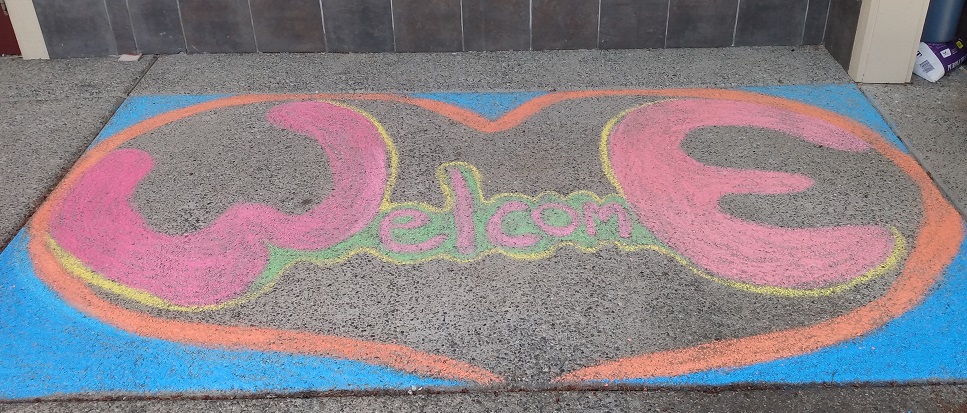
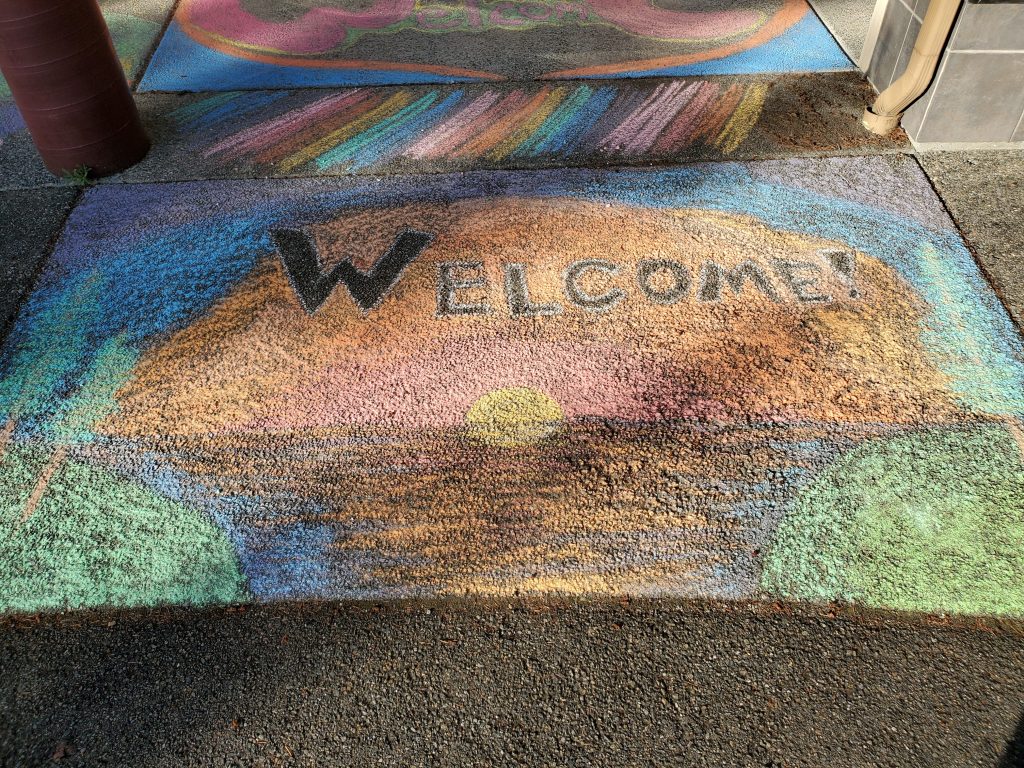
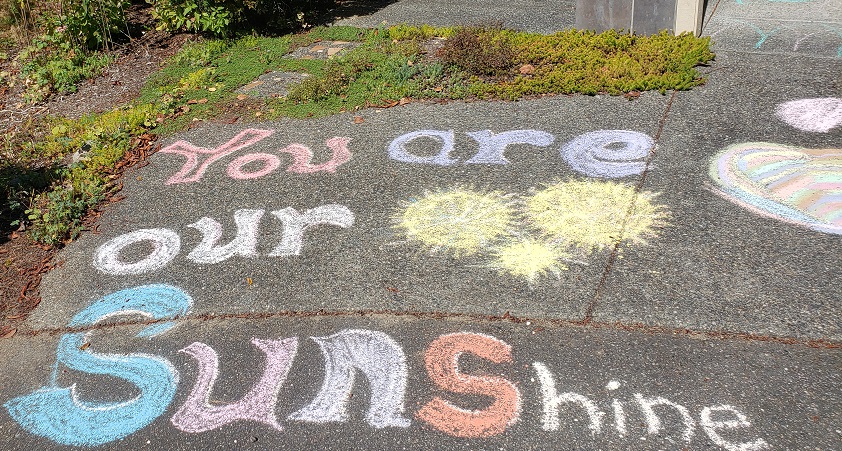
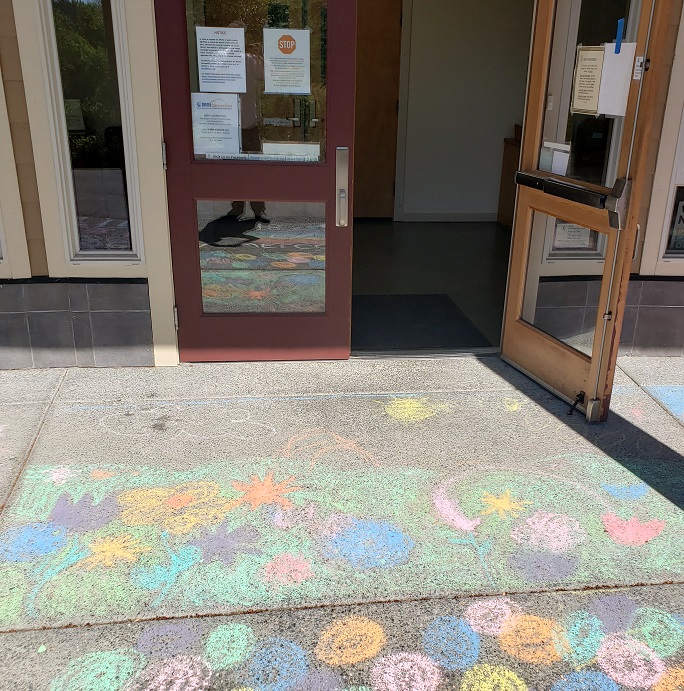
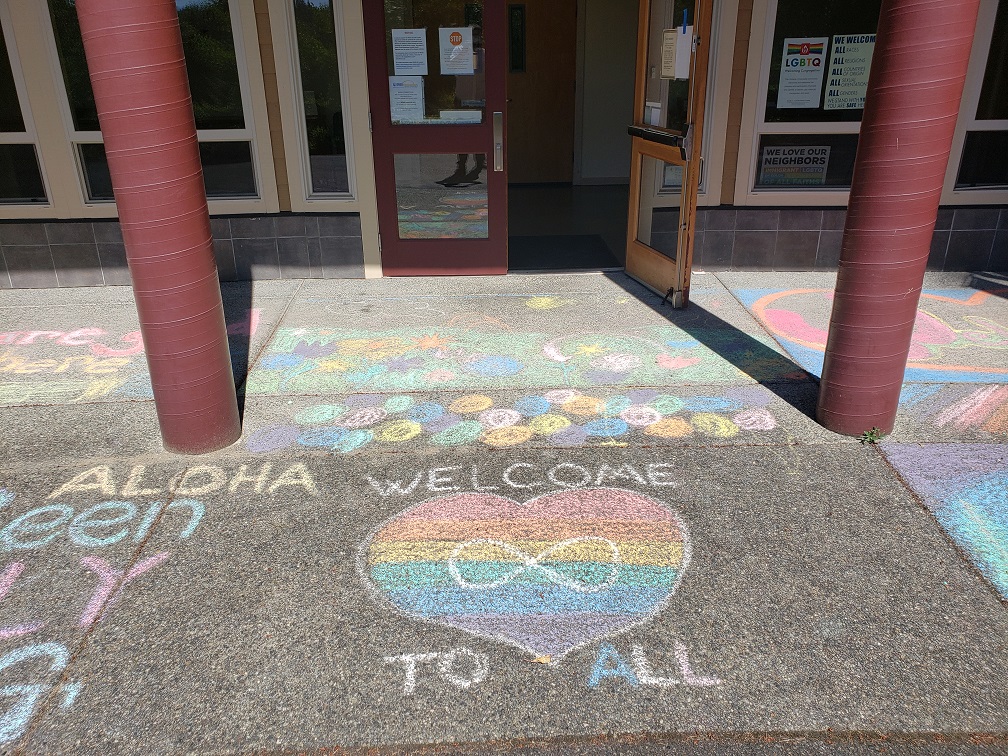
At the direction of Bridget Laflin, Director of Religious Education, WUUC members and their families created a visual celebration Saturday, Aug. 22, for the socially distanced, drive-by meet-and-greet the next day with newly arrived Minister Dan Lillie, his wife Emily Kuo and daughter Natalie Kuo-Lillie. Well done!
Bridget reports: “The first people to arrive were Winny, Sarah and Honomi. They each staked out a spot on either side of the front entrance to create their beautiful pieces. Honomi showed us all a technique of blending the chalk with her hands which added depth to her art. Winny told us about how she used to do chalk art when she was a little girl. She was also super prepared and brought kneepads which she left for other people to use after she left. Thank you, Winny!!!
“Then DD and Hilarie came and added their pieces while they talked and reconnected in the beautiful sunshine.
“Karen Plass came by and chalked her beautiful sunset. She stayed for quite a while, and while she was there, Meg Laflin also came and added her message.
“Then Jessica Belmont and Jen Ikeda arrived. Jessica took the bold move of filling in one of the spaces right in front of the door with and Jen added a beautiful chalice to the mural.
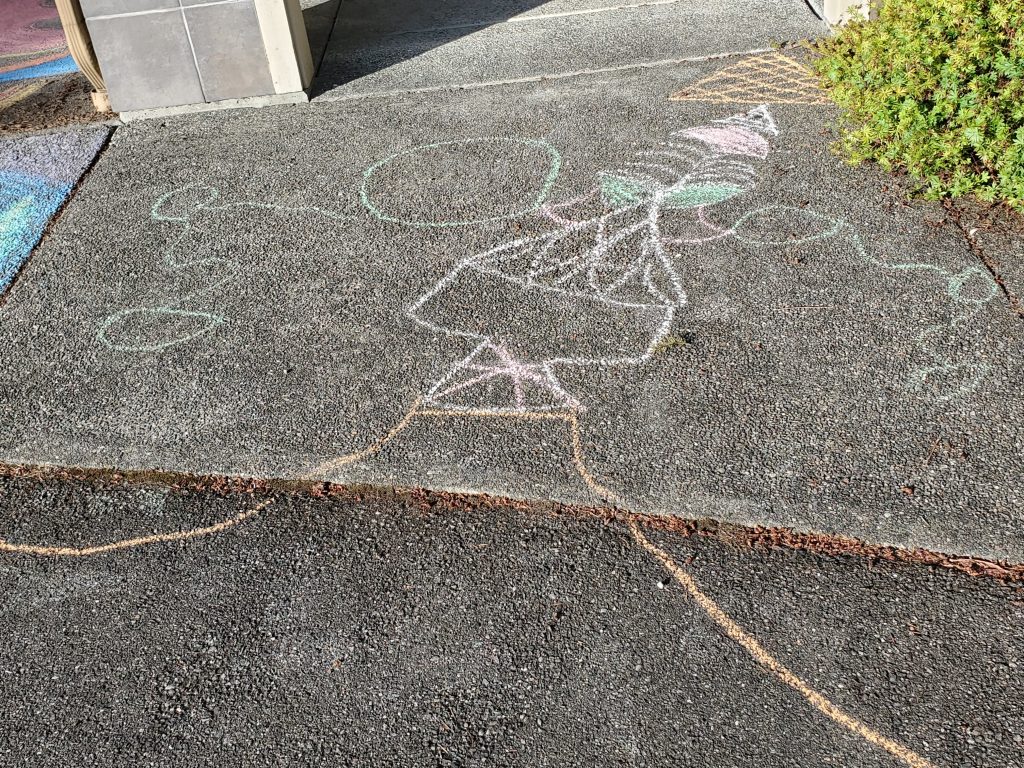
“Finally, the Smith family came and finished it off. The large empty space immediately in front of the door became a flower garden and Kate added some rainbow stripes and circles to fill in the empty spaces between the earlier art pieces. And Grant added a conceptual piece that we determined was a deconstructed ice cream sundae.”
Artists include Karen Plass (top); DD Hilke and Hilarie Cash (left) Chris, Kate, Grant and Neil Smith (center) and Jessica Belmont (right)Grant Smith drew this piece, determined to be a deconstructed ice cream sundae.
(some ponderances from Linda Sherry, largely adapted from this month’s Soul Matters theme, What Does It Mean to Be a People of Renewal?)
As I begin to frame the September Soul Matters theme of Renewal, I find that I have become resigned to a bit of humdrum; that the ongoing struggle to stay safe in this time of COVID has dampened my enthusiasm for Doing and that the current state of affairs in our country and world have made me very weary.
September is a
season of homecoming for us UUs. And renewal is central to that. At the opening
of each new church year, we renew our commitments to each other and our church
community. We renew our energy for another year of journeying together.
In our culture and
secular lives, the questions we ask about renewal focus mainly on health (Are
you drinking enough water? Are you getting enough sleep?”) and work/life
balance (Are you making enough time for family, play and rest?). Those are fine
questions, but they don’t take us very deep or push us very far.
This month’s theme
of Renewal prompts us to renew our very questions about renewal. Perhaps we need to be asking:
Are you sure it’s your body that’s tired, or could it be your soul?
What if “time away” isn’t about restoring
ourselves in order to return to our work, but instead about making space to
decide if it’s time to reconfigure
ourselves and re-imagine what our true “work” is?
Is it time to renew your responsibility to those who will come after you?
Is it time to renew
your commitment to carry on the work of those who came before us?
What if you saw
your daily living and loving as an opportunity (even a calling) to renew
others’ faith in humanity?
Could it be that
continual self-improvement is not the path to renewal but instead compassionate
acceptance of who you already are, warts and all?
What if renewing
our common future isn’t just about moving forward, but instead requires a
return to an honest telling of the past?
And that’s just a
few questions that are sitting on top of the pile!
So friends, this month let’s dig in together and deeply examine the ways and reasons we might find and live Renewal.
Let’s renew and
refresh the renewal questions we ask.
There is a wind that keeps blowing since the
beginning of time, and in every language ever spoken, it continues to whisper,
you must meet the outer world with your inner world or existence will crush
you. If inner does not meet outer, our lives will collapse and vanish. Though
we often think that hiding our inwardness will somehow protect or save us, it
is quite the opposite. The heart is very much like a miraculous balloon. Its
lightness comes from staying full, meeting the days with our heart prevents
collapse.
This is why 90-year old widows remain committed to tending small flowers in the spring; why 10-year olds with very little to eat care for stray kittens, holding them to their skinny chests; why painters going blind paint more; why composers going deaf write great symphonies. This is why when we think when we can’t possibly try again, we let out a sigh that goes back through the centuries, and then, despite all our experience, we inhale and try again.
by John Hartman The world must reduce its carbon emissions by 50 percent by 2030 to have hope for a livable future. And we must be living in a carbon neutral, regenerative world by 2050.
The good news is: We Can Do This!
That’s the conclusion of “The Future We Choose,” a book members of the WUUC Climate Justice Committee have been reading the last couple of months.
The authors — Christiana Figueres and Tom Rivett-Carnac — were among the chief architects of the 2015 Paris Agreement, the landmark accord in which nearly every nation in the world pledged to try to limit the rise in global temperature. Because of this experience, “The Future We Choose” is a mix of solutions-driven optimism and political pragmatism.
The authors are realists. They know that even in a best-case scenario some things will get worse before they get better. The emissions we’ve sent into the atmosphere to date guarantee dangerous heat waves and rising seas for decades to come. But to avoid the worst-case scenario, most countries will have to implement green solutions — many of which already exist or will soon exist. The issue is not the lack of solutions. The issue is the willingness of governments, corporations and individuals to implement the solutions. In much of the book, the authors challenge each individual to do what governments and corporations cannot or will not do. Do not be defeated by short-term setbacks (Stubborn Optimism). See yourself as a citizen not a consumer. Engage in politics. Let go of the old world. Face your grief but hold a vision for the future.
We know we can do this. Since January, the Covid-19 pandemic has led to a shift in human activity around the globe. There are millions of people who have adopted a collective sense of mission — the willingness to restrict our activities for a time to protect the vulnerable. This is the attitude we need to adopt for climate change — to treat it like a crisis we intend to solve.
This is how the authors end the book:
“We want you to know two things.
“First, even at this late hour we still have a choice about our future, and therefore every action we take from this moment forward counts.
“Second, we are capable of making the right choices about our own destiny. We are not doomed to a devastating future, and humanity is not flawed and incapable of responding to big problems, if we act.”
In the October and November WUUC Newsletters, Notes4Earth will discuss sections of The Future We Choose in more detail.