Our new settled minister Dan Lillie will be co-ordained by
Woodinville Unitarian Universalist Church and First Unitarian Church of
Albuquerque on Sunday, October 4.
The act of ordination happens just once for a minister. It
is the moment when a congregation (or sometimes more than one!) affirms a
minister’s call to a lifetime of service to the living tradition of Unitarian
Universalism.
Please attend this special (entirely virtual) ceremony to
show your support and be part of the celebration!
“Without music life would be a mistake. – Friedrich Nietzsch
From the UUA web: “Music
and singing are integral parts of our Unitarian Universalist (UU) worship
services……music shifts the energy of worship and moves it into our bodies.”
By Donna Johnson At our recent Worship Team retreat we spent time with WUUC’s music leaders – Matt Smith (Choir Director), Terry Levitt (Accompanist Plus), and Brad Hull (Special Music Coordinator). WUUC has been very lucky to have these three in place during our many months of Zoom services. They brought amazing renditions of choral pieces, hymns, musical responses, and special music into our homes each Sunday, and they have plans for more ways to use music to “shift the energy of worship” at WUUC in the coming months.
Matt, Terry, and Brad don’t make music all alone. They collaborate with many members of our WUUC community. These members give the gifts of their voices and musical talents when they volunteer to sing in the choir or to create “special music” for our services.
If you have been
thinking about joining the choir or sharing your instrumental and/or vocal musical
talents with us this is the time to step up!
Choir meets each
Thursday evening over zoom. For more information, contact Matt Smith at choirdirector@wuuc.org.
Special musical pieces are used in services most weeks at WUUC. For more information or to volunteer, contact Brad Hull at bkhull@gmail.com.
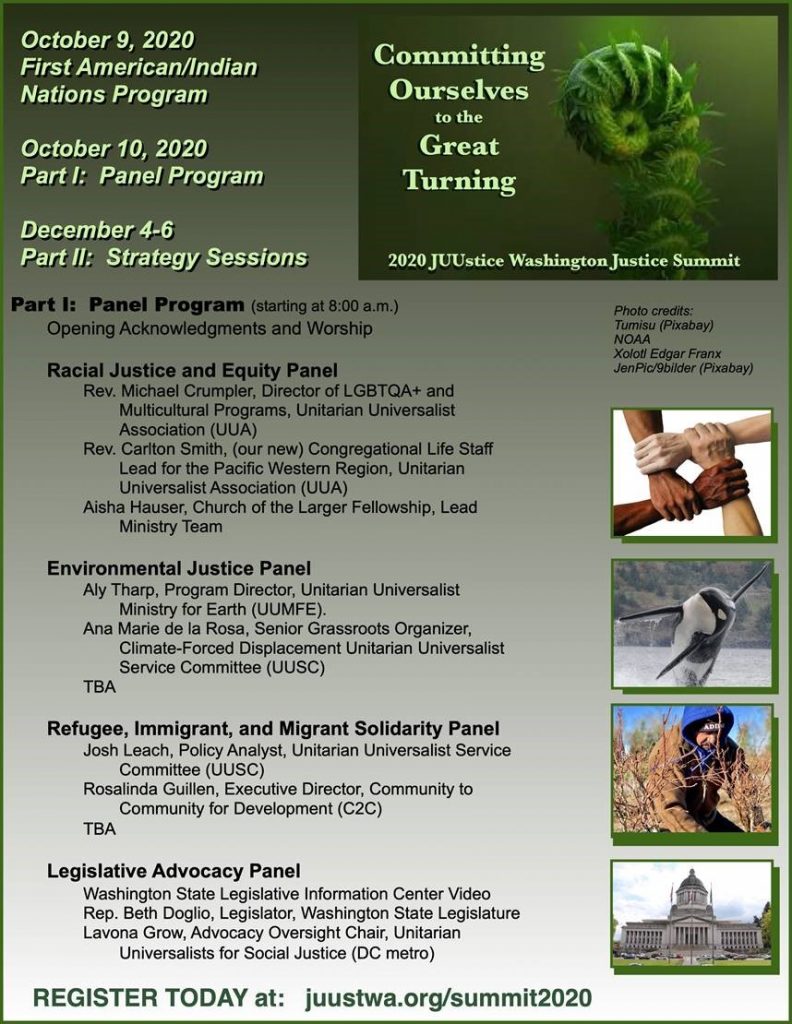
By John HIlke This year, the NW Justice Summit, organized by JUUstice Washington, will be online (for obvious reasons) and this has allowed us to attract a wider range of panelists than in the past. Unlike previous summits, all of 2020 summit programs will be sequential so that you can select the events that you want to attend and not miss any others.
Also new this year, the Summit will reconvene in early December to discuss strategies for justice work in our state and beyond after the elections.
Please register for the NW JUUstice Summit by visiting the JUUstice Washington website — https://juustwa.org/ . Closer to the event, registrants will get information for joining the various online sessions. Feel free to forward the flyer to any folks you know who might be interested.
Please letJohn Hilke know if you have any problem registering.
By Linda Sherry What does it mean to be a people of Deep Listening?
Active Listening, a skillset taught broadly in the ’80s and ’90s, is defined as :
the ability to focus completely on a speaker,
understand their message, comprehend the information and respond thoughtfully.
So how would you define Deep Listening?
This month we will consider listening in more profound ways, ways we might call Deep Listening.
Perhaps when we listen deeply, it is for more than information or exchange of thoughts. Perhaps it is when we listen for the reasons, for the context, for the issues, for the backstory, for the impact. Here are a few thoughts you might want to ponder as WUUC embarks on this month’s theme.
What if listening was really an act of love?
What if listening was really an act of prayer?
Perhaps you’ve
discovered in those rare moments of deep listening that a space suddenly opens
up? A space that feels sacred. A space that, once you’ve experienced it, you
never want to leave.
“To listen deeply is very hard, because it asks of us so much interior stability that we no longer need to prove ourselves by speeches, arguments, statements, or declarations. True listeners no longer have an inner need to make their presence known. They are free to receive, to welcome, to accept.” — Henri Nouwen
“We don’t just listen for clarity and guidance, we listen to become larger. Those voices calling us home are our home. We don’t have conversations, we are our conversations. …
“We must remember friends: Who we listen to is who we become.” — Rev. Scott Tayler
“Listening to both sides of a story will convince you that there is more to a story than both sides.” — Frank Tyger
Do we only listen to the words? What if we listen to the silence between the
words?
Listening in moments without words… a cricket chirps… my heart beats… life is precious… I am filled with gladness.
By Jean Fowler Coming Oct. 19: “Transgender Inclusion in Congregations” – Offered by the Welcoming Congregations Committee
This eight-session Zoom course, beginning on Oct. 19, is designed to support our congregation as we strive to become ever more Welcoming to All – to include being fully inclusive and affirming of people of all genders. Our initial offering will be limited to 12 participants who we ask to commit to attending all 8 sessions between Oct. 19, 2020 and Feb. 8, 2021 from 7-9 p.m. Register for the course at:
Several members of the Welcoming Congregation Committee have
gone through this curriculum themselves and highly recommend it.
The course was created by the Transforming Hearts Collective, a team of amazing trans UU religious professionals, and uses pre-recorded videos and guided conversations to deepen our understanding of gender identity and expression in spiritual community. This class is an important step in living WUUC’s Welcome Congregations commitment, and we invite you to be part of it.
This curriculum was developed by a collective of individuals that include Zr. Alex Kapitan and Rev. Mykal Slack, who are the presenters of the course. Many of you may remember Rev. Mykal Slack’s prayer during the Sunday service at this year’s Unitarian Universalist General Assembly [[https://www.uua.org/ga/off-site/2020/sunday-worship (starting at 30 minutes and 30 seconds into the video)]
Through six hour-long video lectures, followed by Zoom group
discussions, we will:
** explore mainstream narratives
about who trans people are;
** explore our understanding of
non-binary identities and
** enhance our
skills in relationship-building
Participants
will be asked to watch each video prior to the group gathering where we will
consider discussion questions, share personal experiences and reflect on our
understanding of gender-based issues.
The last session will focus on how we can put our learning into practice
and enhance WUUC’s Welcome to All.
Part II: Three Mindsets: Stubborn Optimism, Endless Abundance, Radical
Regeneration
Synopsis by Janice Anthony
“Impossible is not a fact. It is an
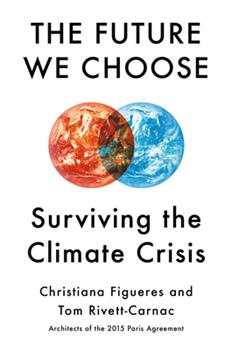
attitude.” Authors Christiana Figueres and Tom Rivett-Carnac remind us that
optimism is not the result of happy outcomes. It’s the mindset which we
cultivate in ourselves and which moves us forward to succeed against that which
appears too unrealistic to achieve.
One of the false mindsets that we as
humans adhere to is that of scarcity. It leads us to compete, to hoard, to take
too much at the expense of others. We believe that in order to get ahead,
someone else must lose out. The authors give the example of the perceived water
shortage in Tucson, where the actual rainfall is greater than the municipal
water actually consumed annually. In situations of true scarcity, such as in
the aftermath of natural disasters and even terrorist attacks, the way human
beings most often react is in a collaborative fashion. The authors propose that
such collaboration is the necessary, indeed the only option for dealing with
the climate crisis. Changing our mindset is an absolute necessity for a
successful outcome.
Developing this idea further, the
authors argue that no amount of carbon budgeting is viable. We shouldn’t be
negotiating each country’s allowable amount of carbon production, or how much
carbon is acceptable for each individual worldwide, because these methods
follow the model of competition rather than collaboration. We’re all in this
together and we all need to pull together with a new zero-sum model. We need to
believe with stubborn optimism that we can do it. The authors themselves did the
“impossible” as they helped to construct the Paris Agreement of 2015, an
achievement they themselves had doubts about in the very beginning. Their first
act was to change their own thinking.
One of the next steps is to move away
from the conventional “linear growth” model we’ve been following, which relies
on extraction. We are now called to pursue regenerative growth. Rather than
thinking in terms of extraction, we need to think in terms of actions which
support humanity and nature. Nations must change their collective thinking, realizing
that when all nations work to reduce carbon emissions everyone benefits. This
thinking begins with ourselves on an individual level. Connecting with nature
is regenerative; and restoring nature and ecosystems is necessary for us to
survive on a physical and a psychological level.
The authors provide an array of ideas
and facts to consider. This is an easy-to-read book with a real “Wow” factor; a
refreshing outlook which leads the reader to the realization that bringing the
earth back to a state of health is achievable.
(The next newsletter will include a review of the final part of “The Future We Choose,” the 10 actions we can take to be on an effective trajectory.)