Often we hunger for healing but don’t know what it will take to
make our way there. The goal is elusive. The path is unclear.
Rarely, if ever, are any of us healed in isolation. Healing is an act of communion. bell hooks
But what if the work is to travel
toward our suffering? What if proximity to pain, not distance from it, is the
real route to healing?
When we hold our suffering in a way that opens us to
greater compassion, heartbreak becomes a source of healing, deepening our
empathy for others who suffer and extending our ability to reach out to them. – Parker Palmer
Remember that healing words aren’t always easy or immediately
comforting. Sometimes the words we need to hear the most are the ones that are
hard to hear or grab us by the shoulders and shake us awake.
The truth is that things don’t really get solved. They come together and they fall apart. Then they come together again and fall apart again. It’s just like that. The healing comes from letting there be room for all of this to happen: room for grief, for relief, for misery, for joy. Pema Chödrön
Until we widen our view and notice that there are circumstances wounding us both, the painful gap between us will never heal. Rev. Kaaren Anderson
Be kind, for everyone you meet is fighting a battle you know nothing about. Wendy Mass
* *
*
Each month, WUUC is exploring a theme suggested by the
UUA program Soul Matters. Materials are
provided for small groups and for worship themes related to each topic. The reflections above are from those
materials, and compiled by Linda Sherry.
Art: The expression or application of human creative skill and imagination, typically in a visual form such as painting or sculpture, producing works to be appreciated primarily for their beauty or emotional power. ‘(Oxford Dictionary)
“The foremost reason that artists create, and the rest of us value their art, is because art forms a priceless living bridge between the everyday psychology of our minds and the universal spirit of humanity…….This is the thing: art comes from the heart and, likewise, speaks to the heart; but this asks something of the witness, too, a kind of emotional and spiritual sensitivity with which to receive the generous gift of the artist.” (Larry Culliford, Spiritual Wisdom for Secular Times)
We are blessed to have writers, musicians and artists who encourage one another, who collaborate, and who contribute to Sunday Service every week. Knowing what music you love, what captured your eye while you were hiking, or what stories you have to tell lets us see you. These shared insights enrich our worship services with art’s “emotional power” and ability to help us “bridge to the universal spirit of humanity.” The creative gifts we share are making new connections, inspiring others to express themselves and share their own perspectives, and contributing to our identity as a community. That is a ministry.
For the past months, we have been using the art of WUUC members and friends during the service to enhance our meditation and musical experiences. Now, we are also sharing this art as part of a slide show in the 10 minutes before the service starts each week – the Zoom version of the art that we used to enjoy in the foyer when we were having services in the sanctuary. Thank you to those who have sent in their work. As creative people, we get to show who we are, what we are obsessed with, how we are doing in the moment we are creating, and what matters to us.
Visual Arts Ministry
This re-forming team has a new focus now that our gallery is virtual. The participation of our congregation is unprecedented and inspiring. If you’d like to work on this exciting project with creative people (who are always fun) send a message to Marlene Katz mkatz@wuuc.org
How to Contribute images and video
Best way: Upload files to the graphics folder in Drive, make sure they are named correctly. You can edit names in Drive after uploading.
Original Artwork: any medium, any PG subject but we are especially fond of kid artwork, pet portraits, and kid pet portraits.
Photographing artwork is tricky, try to avoid shadows and glare, and get as close as you can. Make sure the image is big enough; a general guide is Horizontal (landscape) – 1,024 x 512 Vertical (portrait) – 800 x 1,200 Most smartphones do fine.
What happens next:
New files organized
We will use them when it is appropriate for the context. We may contact you asking for permission to use your image in a graphic for church. We don’t know when we’ll use your contribution, but we hope we can use them all.
Credits and Releases:
Your original work only
If you wish to be credited, name your files with your name & the title.
Khyams frog.jpg is a good example.
Make sure you have everyone’s permission to publish photos that they are in. Photo release forms are required for children.
By Jan Radoslovich The October 2020 Soul Matters theme was “Deep Listening.” WUUC’s Lay Pastoral Associates (LPAs) and Rev. Dan would like to take this opportunity to share some of the skills we use for deep listening.Each of us in the congregation can have the opportunity to provide care to each other in times of need. Deep listening has an important role in enabling us to support each other in our beloved community.
Why do
it?
Practicing
and developing deep listening skills can offer the “quality of listening that
is possible among a circle of human beings, who by their attentiveness to one
another create a space in which each person is able to give voice to the truth
of their life.” Rebecca Parker
Deep
Listening Includes:
Being aware of your own ability and
readiness to engage with the speaker.
Being fully present in the “here and
now” with the speaker, tuned in to the experiences, feelings and needs
expressed in this moment.
Being attentive to the speaker’s
speech and body language for deeper meaning, unspoken needs and feelings
conveyed.
Being aware that the speaker’s
experiences and points of view may not be the same as yours, and your role is
to understand and reflect, not judge or agree.
Asking questions to encourage the
speaker to clarify their thinking and feelings in order to more fully understand
their truth.
How to
Practice Deep Listening:
Center
the speaker as the focus of the conversation
You are present for the speaker. Keep the focus on the needs of the speaker as they talk. Avoid statements or comments that redirect the conversation back to you as the listener. Ex. “That reminds me of something similar that happened to me.” Avoid statements or comments that change the subject. Ex. “Speaking of anger, did you see the movie about….”
Emphasize
the “here-and-now”
What does the speaker need “here-and-now?” What is happening for the speaker “here-and-now?” Avoid reassuring cliches, which tend to minimize the significance of the feelings and convey a lack of understanding or support. Ex. “It will all work out.” “Everyone feels that way.” “It’s not as bad as you think.” “The universe has a plan for everything.”
Focus
on feelings
Ask questions about feelings. Use active listening skills such as: reflecting, probing, supporting to convey interest in understanding feelings. Verbalize implied feelings to validate understanding and help the speaker become more aware of their feelings. Ask the speaker to describe in words how they are feeling right now. Ask the speaker to describe how they feel about the situation.
Balance
words with silence
Use silence to slow the pace of the conversation. This gives the speaker time to reflect upon, then speak further about feelings and insights that have arisen from their sharing. As a listener, become comfortable with the uncomfortable void of silence. The speaker is doing their internal work during this void.
Show
empathy and respect
Empathy is doing our best to see and experience the world or situation from the perspective of the speaker. Respect is offering regard for the speaker’s perceptions, opinions, feelings, needs and personhood. This can be done with simple phrases, “I hear what you are saying,” “I understand,” “This is a difficult time for you,” “Thank you for sharing so openly with me.”
In
summary
“To listen is very hard, because it asks of us so much interior stability that we no longer need to prove ourselves by speeches, arguments, statements or declarations. True listeners no longer have an inner need to make their presence known. They are free to receive, to welcome, to accept.” Henri Nouwen
Are you willing to be a deep
listener?
Authored by Jan Radoslovich, lay pastoral associate, with guidance from Soul Matters, What Does it Mean to Be a People of DEEP LISTENING? October 2020.
By Carol Taylor Join us for 21 days of learning, reflection, discussion, and action. Spend a few minutes each day exploring videos and readings on a different topic. Get the opportunity to share your thoughts and plans with others in the community. Sign up here to participate.
Understand the origins of the concept of race, how it influences us as individuals and as a culture, and how it functions to preserve inequity in our laws, institutions, and systems.
Inspect the disparities in health, wealth and well-being that are largely a result of racism enshrined in public policy over the course of U.S. history.
WUUC is trying this out as an unmoderated learning group in November. We will then review and evaluate running it again next year.
Adapted from Michigan League for Public Policy who developed this program to achieve their mission of economic security for all Michiganders by applying a racial equity lens to their anti-poverty work.
Why are we doing this? Without understanding the origins of the concept of race, how it influences us as individuals and as an organization, and how it functions to preserve inequity in our laws, institutions and systems we won’t be able to truly achieve the justice, equity, and compassion in human relations that we’re committed to as UUs.
By signing up you’ll receive the Zoom link for the challenge kick-off, a link to the daily challenge content, weekly reminders, and the opportunity to share your thoughts and plans with others participating as part of this WUUC community activity.
Note: Bridget Laflin is planning to offer an alternative version for families, children and youth. Contact bridgetdre@wuuc.org for additional information.
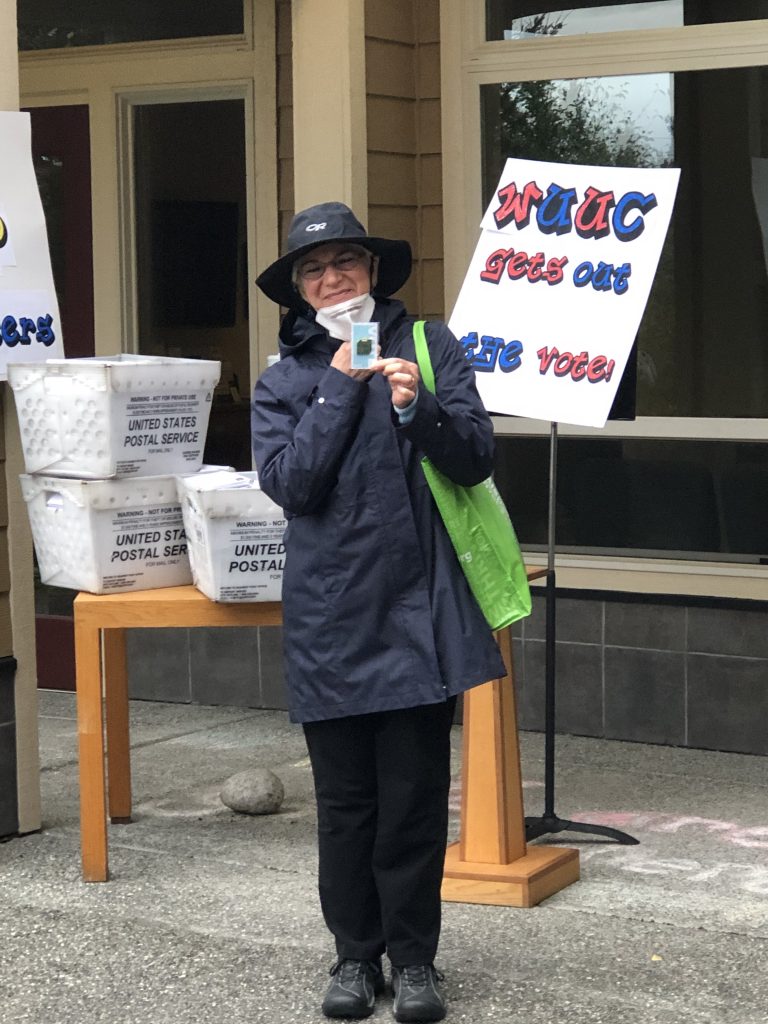
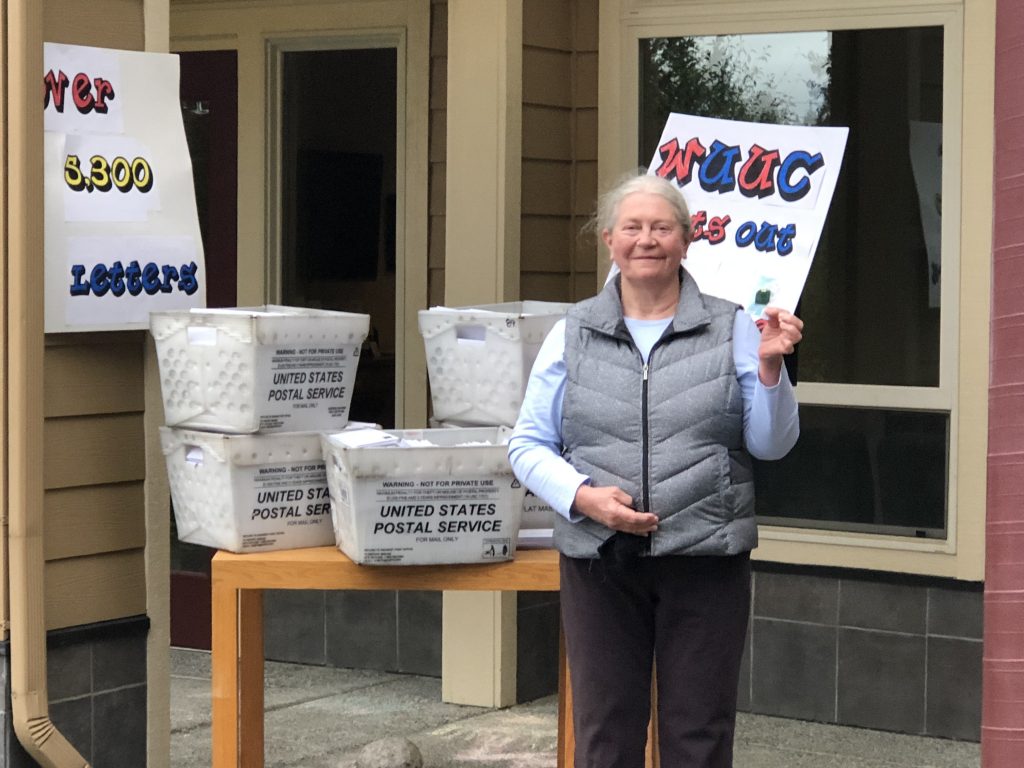
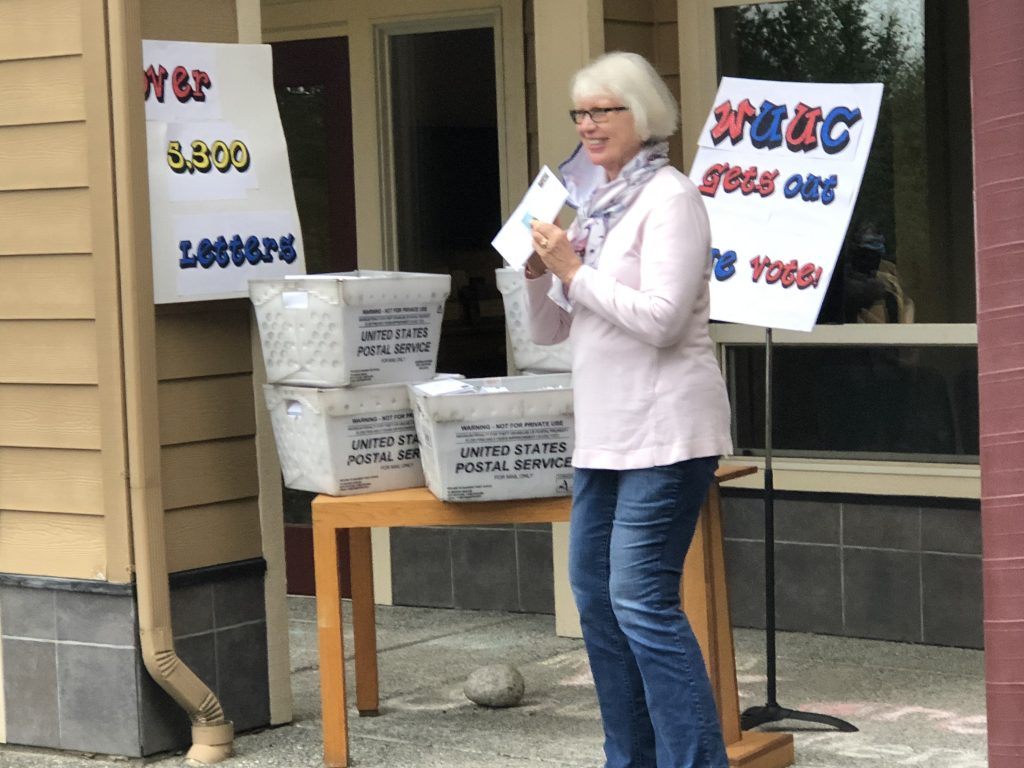
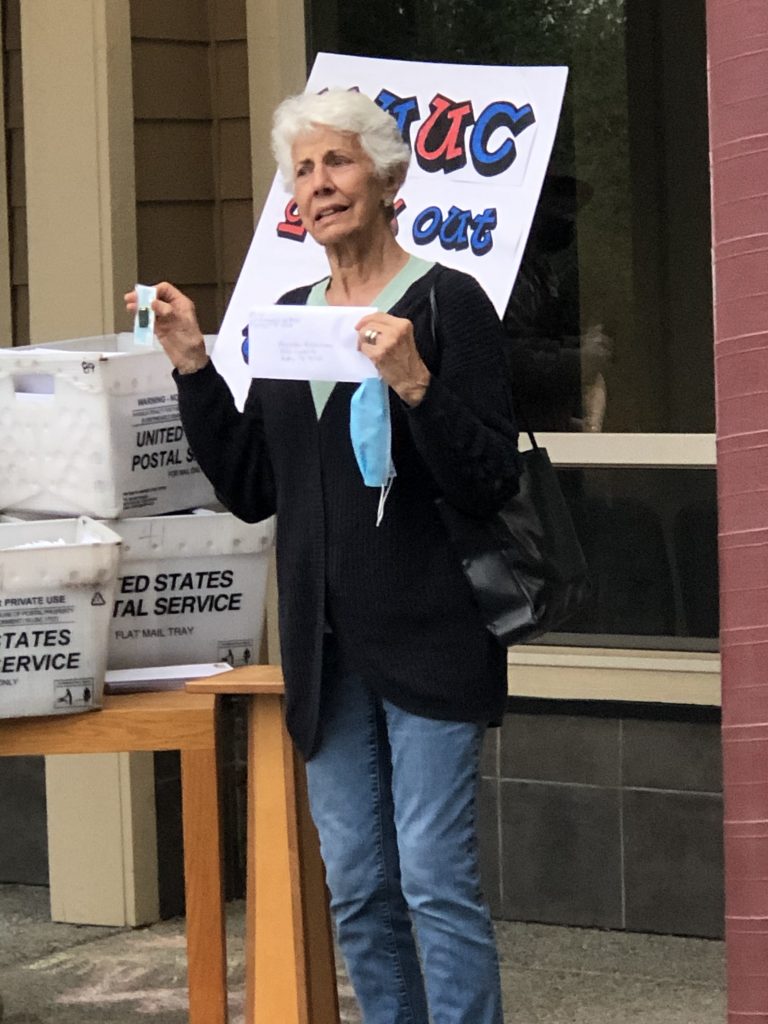
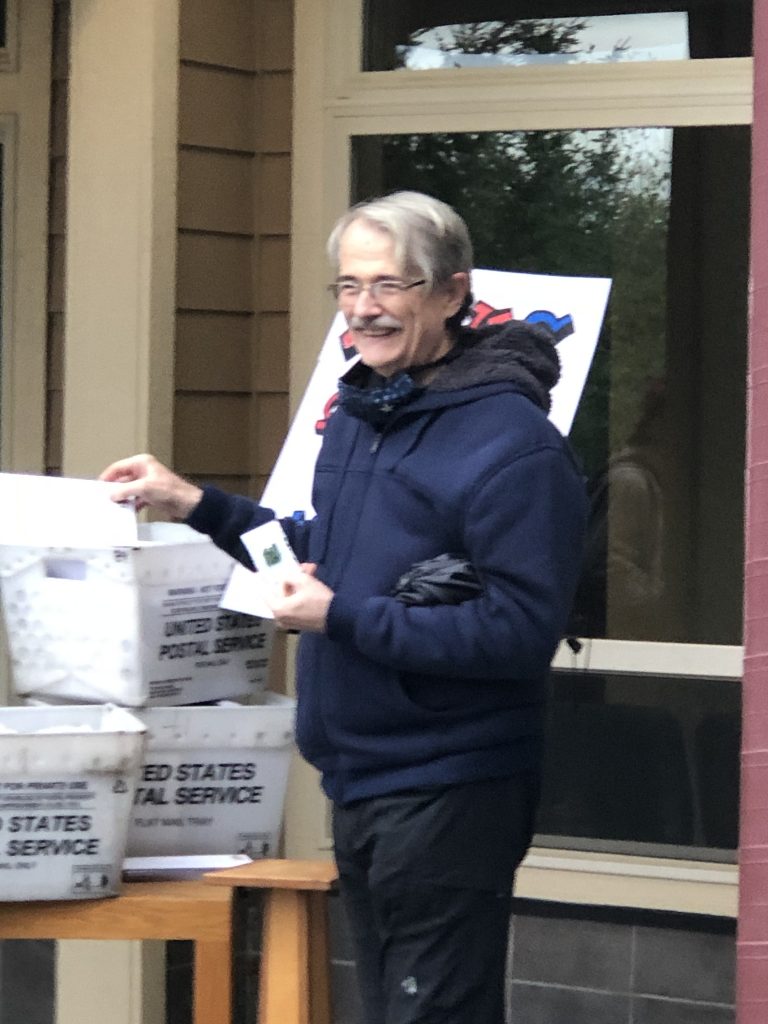
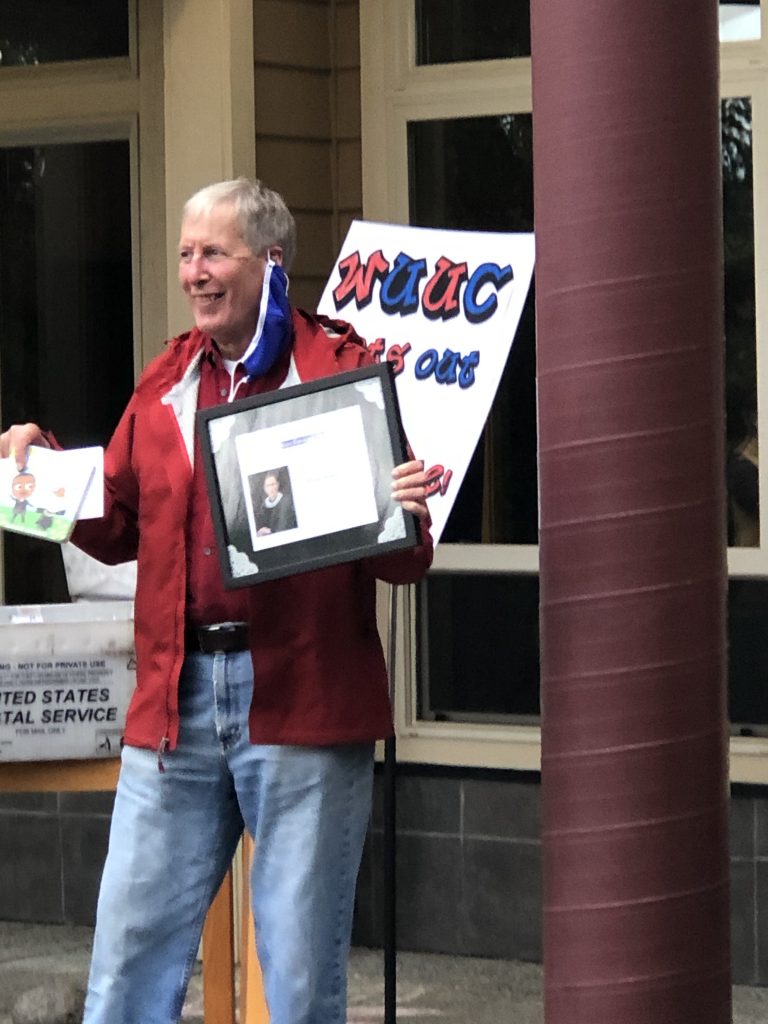
By John Hartman On Oct. 16, WUUC celebrated the completion of the Vote Forward, Get Out the Vote letter-writing initiative.
Over the last 7½ months, 42 WUUC letter writers wrote a total of 5,405 letters. The letters are targeted to registered voters in Texas and Nevada who are infrequent voters. The letters were mailed on Oct. 16, with hopes that they reach the hearts of these voters and they help to make a difference in voter turnout this year.
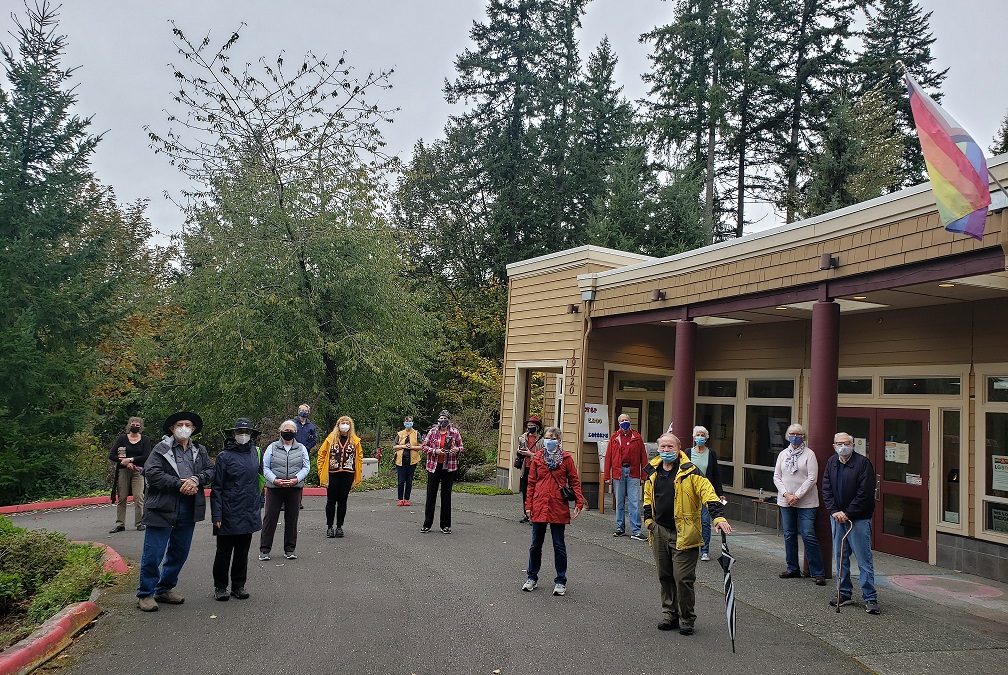
We had a brief, socially distanced, gathering outside WUUC to celebrate the success of the project and award prizes to the top letter writers.
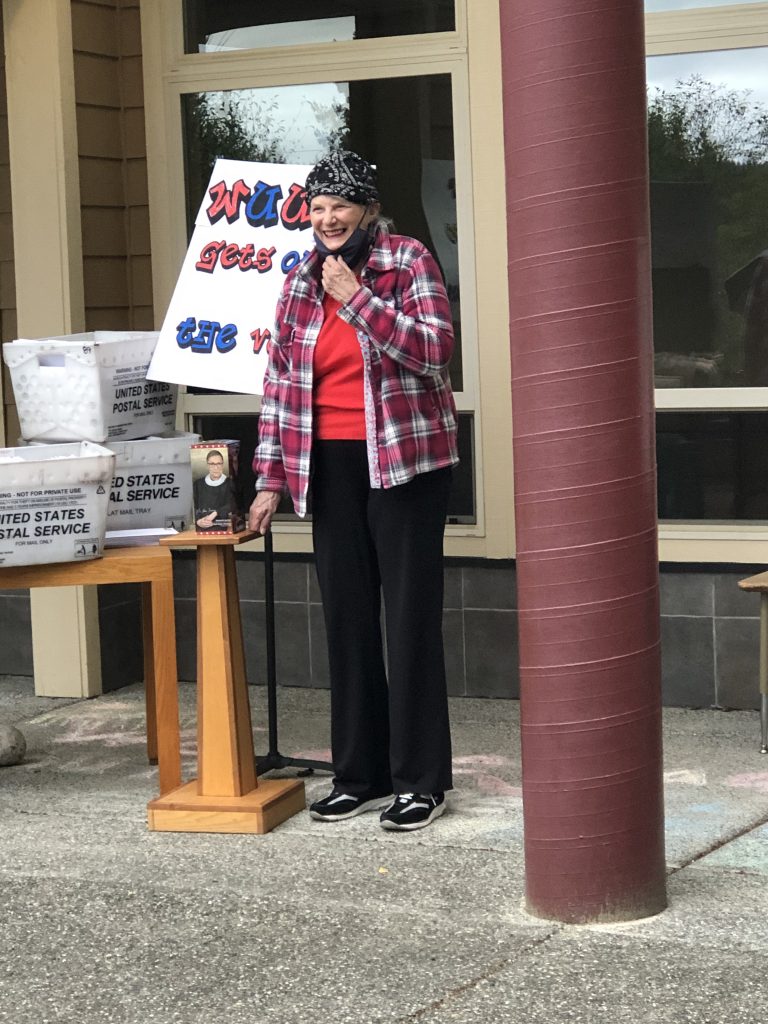
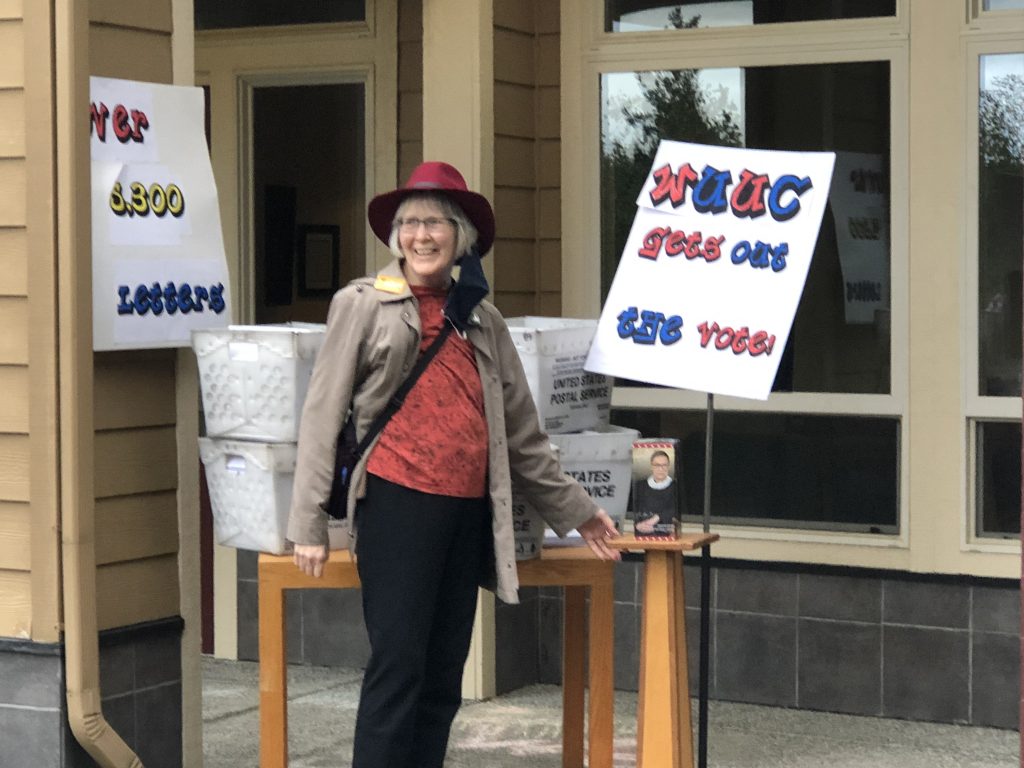
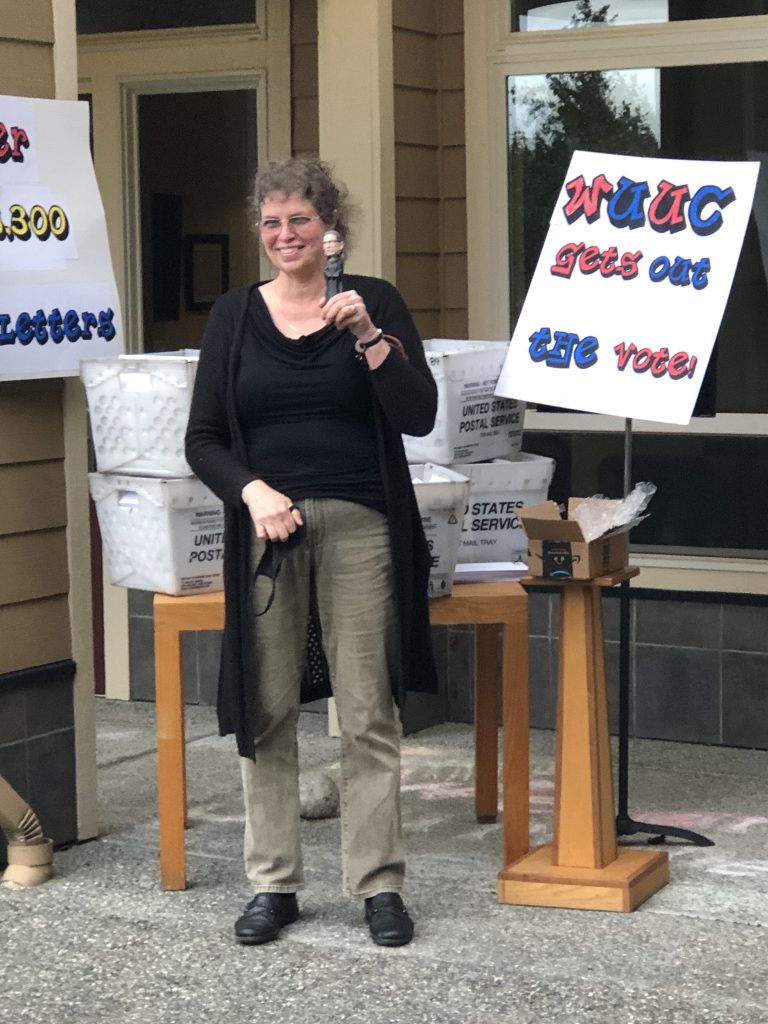
The top three letter writers received Ruth Bader Ginsburg bobblehead dolls:
Top letter writers include, from left, Lou Anne Maxwell, Jane Mathewson and Jan Anderson.
Lou Anne Maxwell – who wrote 500 letters.
Jane Mathewson – who wrote 420 letters.
Jan Anderson – who wrote 400 letters.
Everyone who wrote at least 200 letters received a “Let People Vote” pin:
Displaying their “Let People Vote” pins are, from left, Janice Anthony, Marilyn Schmitt and Grace Simons.
Janice Anthony – who wrote 370 letters
Marilyn Schmitt – who wrote 350 letters
Hilarie Cash – who wrote 320 letters
Grace Simons – who wrote 220 letters
Stephana Ditzler – who wrote 200 letters
John Hilke – who wrote 200 letters.
Stephana Ditzler and John Hilke each wrote 200 letters, while John Hartman coordinated the entire effort.
Thanks to everyone who participated in this project. I am so grateful this resonated with so many people in WUUC.